
Syrian, 1934-1978
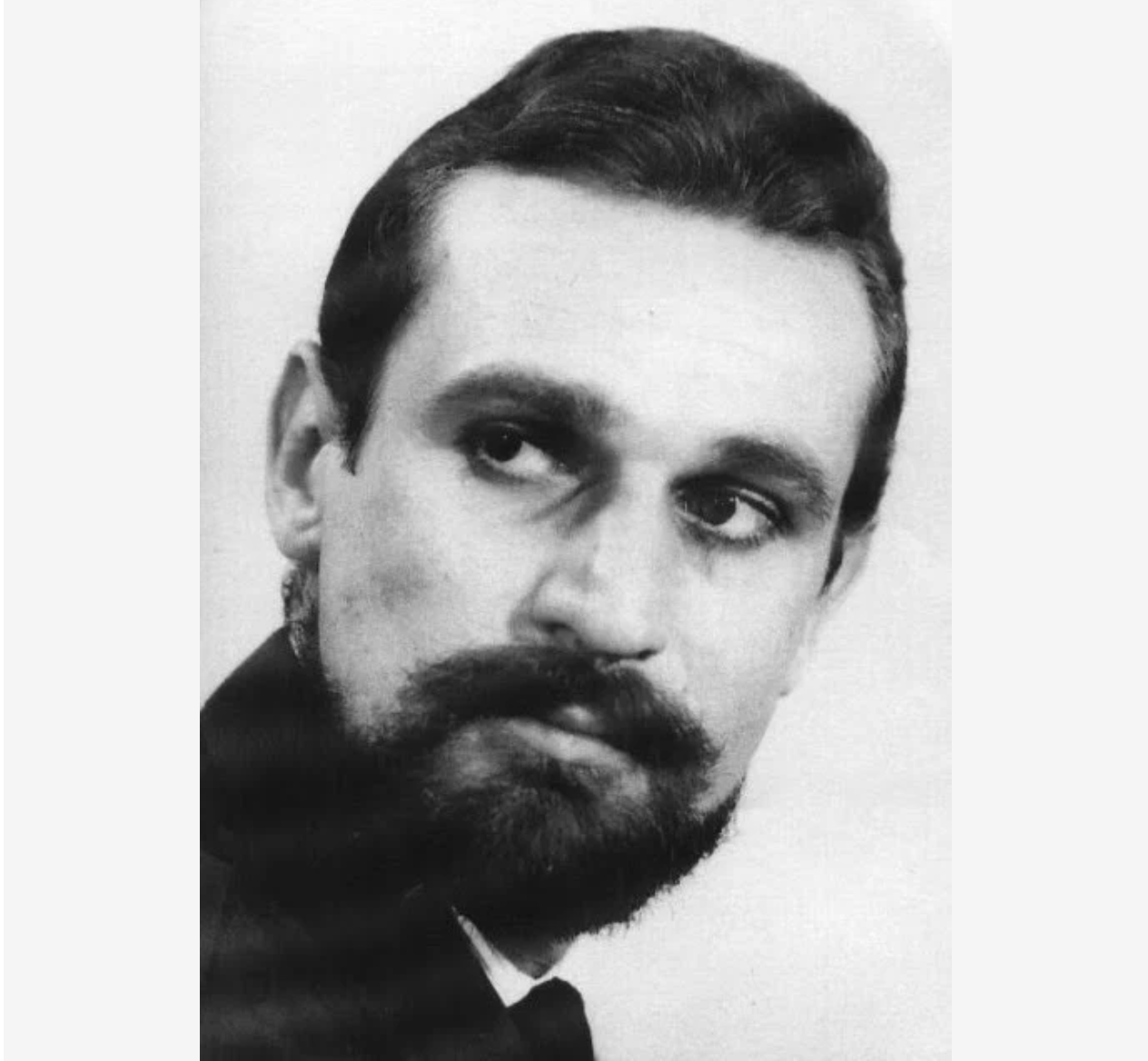
Louay Kayyali began painting at the age of eleven and held his first solo exhibition at eighteen. Those two facts together tell you something about the particular quality of his relationship with art, not a hobby that became a vocation, not a talent discovered late, but a compulsion that arrived in childhood and never loosened its grip.
He was born in Aleppo in January 1934, into a Syria that was still under French mandate, and grew up in the years of independence and nation-building that followed. His body of work is known for its portraits of people within the contexts of political and social change, as Syria transitioned to a modern and independent nation, and more than a simple pictorial representation, Kayyali looked for the inner spirit of the Syrian people to capture their essence and emotions. He was painting Syria’s people at the exact moment Syria was deciding what it was, and the two projects, the national and the artistic, were inseparable in his work.
Aleppo to Rome
In 1956, Kayyali was granted a scholarship by the Ministry of Education to study painting at the Academy of Fine Arts in Rome, an opportunity that proved formative in ways that went well beyond technique. Rome in the late 1950s was a city still rebuilding from the war, saturated with social realism and politically engaged art, and Kayyali arrived in that environment with a sensibility that was already inclined toward the same concerns.
He participated in a range of art fairs and won awards, including the Golden Medal for Foreigners in Ravenna, and in 1959 founded the first of a series of art fairs at La Fonta Nella Hall in Rome. The institutional recognition was meaningful, but the more lasting development was a friendship forged in Rome with fellow Syrian artist Fateh Moudarres, introduced to Kayyali in 1955 by their shared mentor Wahbi al-Hariri.
Moudarres and Kayyali would go on to represent Syrian modern art together at the 1960 Venice Biennale, placing Syrian painting on the most prestigious contemporary art stage in the world at a moment when the country was still forming its cultural identity.
The Work and Its Language
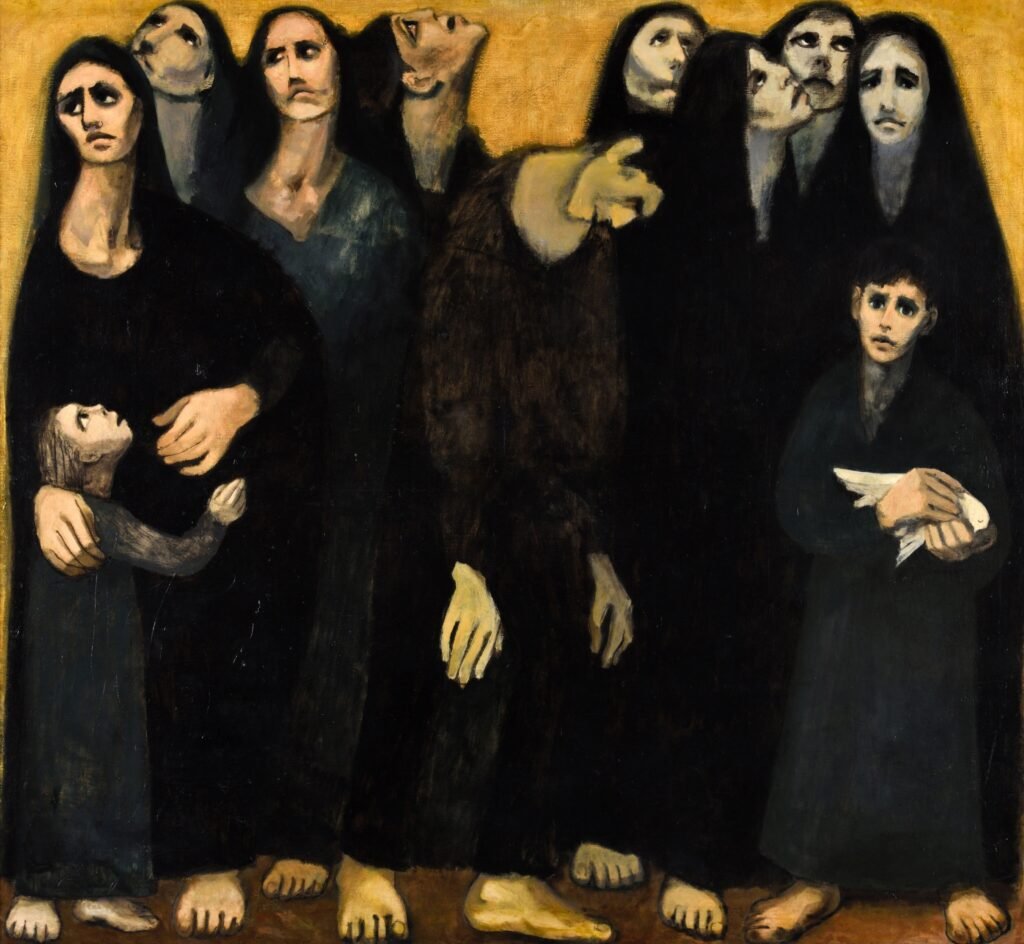
Regarded as one of Syria’s most influential artists, Kayyali’s work addresses social issues and scenes from daily life, merchants, landscapes, and still lifes that mix realism and expressionism, working mostly in oil paint on wood or pencil on paper, characterised by a simplicity in colour and shape. His subjects were never grand historical figures or mythological constructs. They were seamstresses, readers, labourers, women in blue house dresses absorbed in private moments, the people that formal portraiture had systematically ignored.
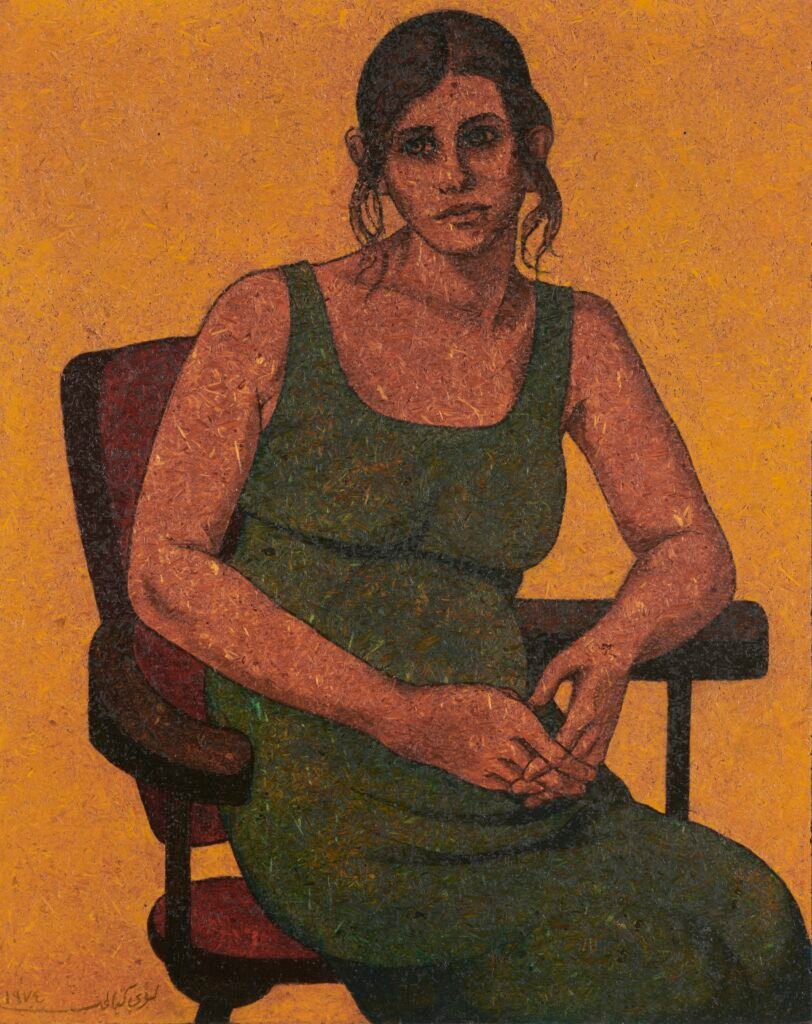
His signature technique of painting on masonite chipboard contributed to the worn-yet-resolute nature of his solidly defined figures, often rendered with quiet, downcast gazes. The chipboard was not an accident or an economy; it gave the surfaces a texture that felt lived-in and weathered, a material quality that matched the emotional register of the subjects themselves.
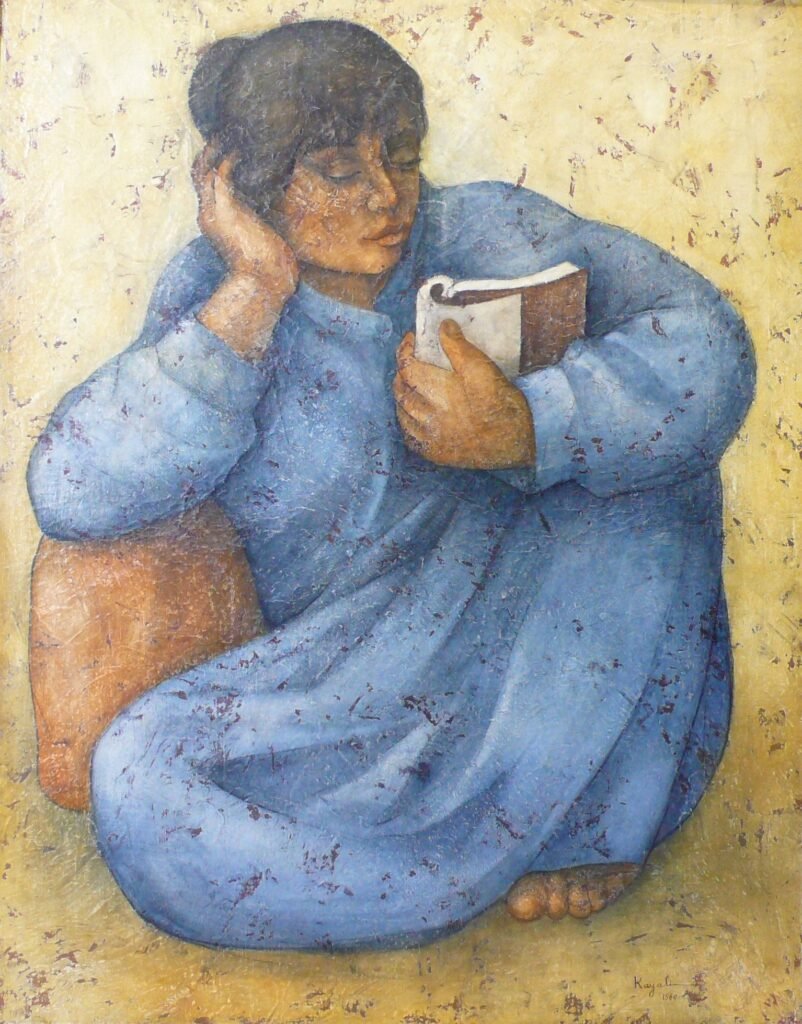
In Woman Reading (1960), Kayyali almost glorified an anonymous and humble woman as he shrouded her with a golden light, a woman resting on an orange cushion, absorbed in her reading, wearing a blue house dress that signals privacy rather than performance. She is not posing. She does not know she is being looked at.
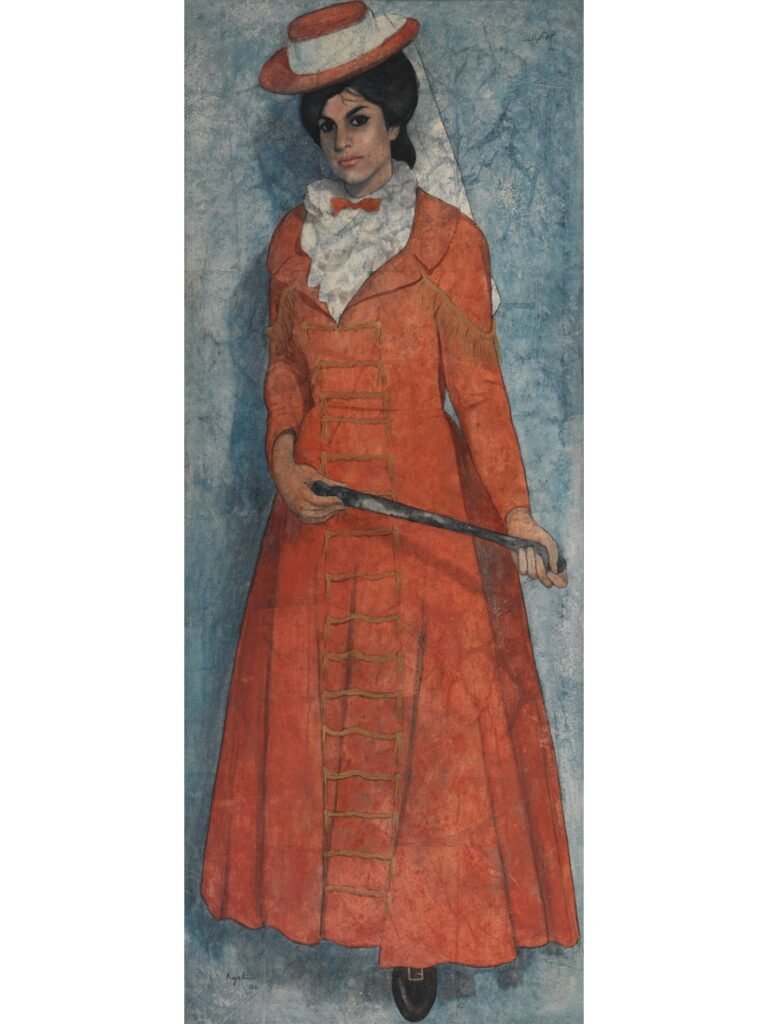
That quality, of catching people in the midst of their actual lives rather than their performed ones, runs through everything Kayyali made at his best, and it is what gives the work its lasting power. Even though the scene is realistic and common, Kayyali added some fantasy to the composition, a golden light that should not logically be there, a warmth that transforms the ordinary into something worth preserving.
The Depression and the Silence
In the mid-1960s, Kayyali began to show signs of serious depression, which was reflected in his art through dark and mournful charcoal works. The shift was not merely stylistic; it was a rupture. The warm, humanist paintings of women reading and seamstresses at work gave way to something darker and more politically urgent.
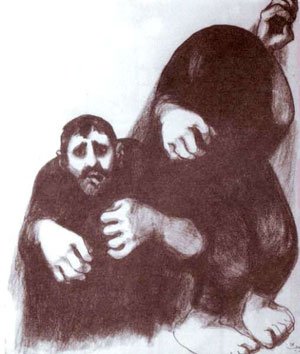
In 1966, he developed symptoms of a psychological crisis, and driven by his desire to highlight social injustices, he began painting a series of charcoal works depicting torture and the struggle of man. In 1967, he presented an exhibition entitled For the Sake of Cause, thirty politically charged works shown at the Damascus Arab Cultural Centre, which travelled throughout Syria and received very mixed reviews from critics, as well as a great deal of personal criticism from his fellow artists.
What happened next was one of the most painful acts of self-destruction in the history of Arab art. Hurt by the negative reception, Kayyali destroyed all the works from the exhibition and stopped painting.
He disappeared from public artistic life, became increasingly isolated in his Damascus home, and entered a long period of treatment for his deteriorating mental health. The depression was not a narrative detail in his biography; it was a structural force that shaped everything that followed, repeatedly pulling him back from recovery just as recovery seemed within reach.
The Final Years
Kayyali returned to teaching at the Faculty of Fine Arts in Damascus at the end of 1969, but when his father passed away in Aleppo in 1970, his psychological health declined again. He continued to paint under medical care, and by the early 1970s was living on a modest monthly pension. It was not until 1973 that he began to work seriously again, and in 1974 organised an exhibition at the People’s Hall for Fine Arts in Damascus, 42 paintings, all of which were sold before the exhibition even closed. That detail is striking. After years of illness, isolation, and the self-inflicted destruction of an entire body of work, the market’s response to his return was immediate and total.
In 1977, he travelled to Rome in an attempt to revive his interest in painting and battle his ongoing depression, only to return a few months later defeated and addicted to tranquillisers. He died in January 1978, six days after his 44th birthday, from severe burns sustained when a cigarette set his bed on fire while he was sleeping. His works are held in the International Modern Art Hall of Damascus and in major collections across the Arab world, including the Barjeel Art Foundation in Sharjah and Qatar Museums. He was 44 years old. The work he left behind, across a career interrupted by illness and self-doubt and the destruction of his own canvases, is enough to establish him as one of the most significant painters Arab modernism produced, and one of the most human.