
From inherited weaving traditions to large-scale installations, Arab artists are transforming textiles into powerful expressions of memory, identity, and belonging.
Fabric has always carried stories. Across the Arab world, weaving and embroidery have preserved family histories, cultural traditions, and knowledge passed between generations. Today, a growing number of contemporary artists are taking these familiar materials beyond their traditional settings. They are turning them into installations, sculptures, and conceptual artworks that challenge how we understand craft and fine art.
This shift is particularly visible in the Gulf, where artists are revisiting inherited techniques while developing new relationships with material, memory, and place. Their work does not simply preserve tradition. It asks what happens when familiar materials enter unfamiliar artistic contexts.
An exhibition currently on view at Dubai’s ICD Brookfield Place brings this conversation into focus.
When Fabric Becomes an Archive
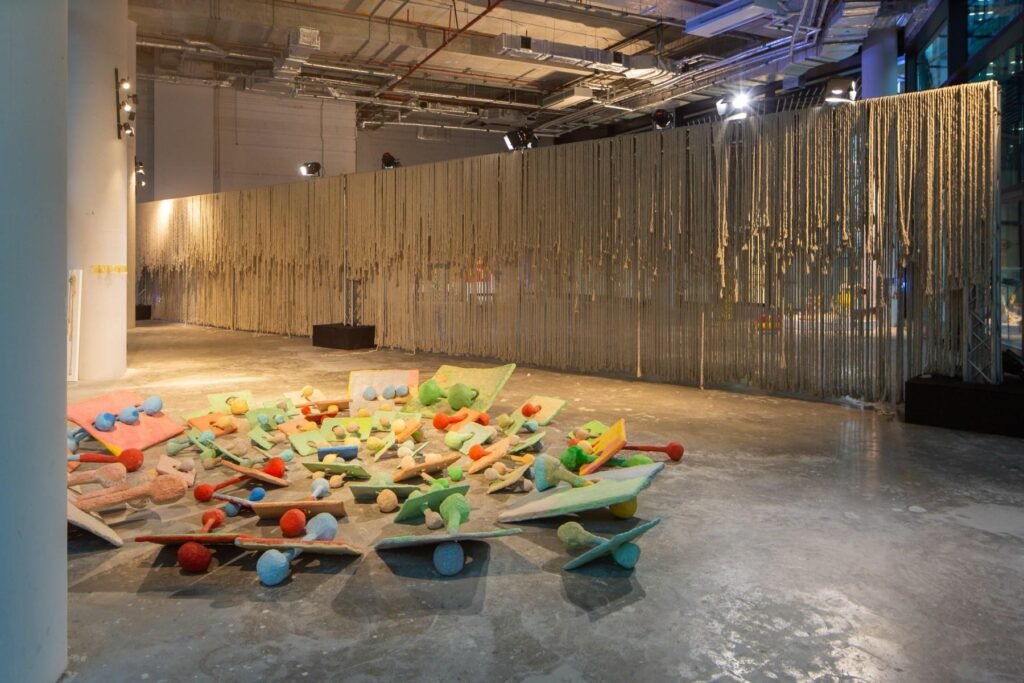
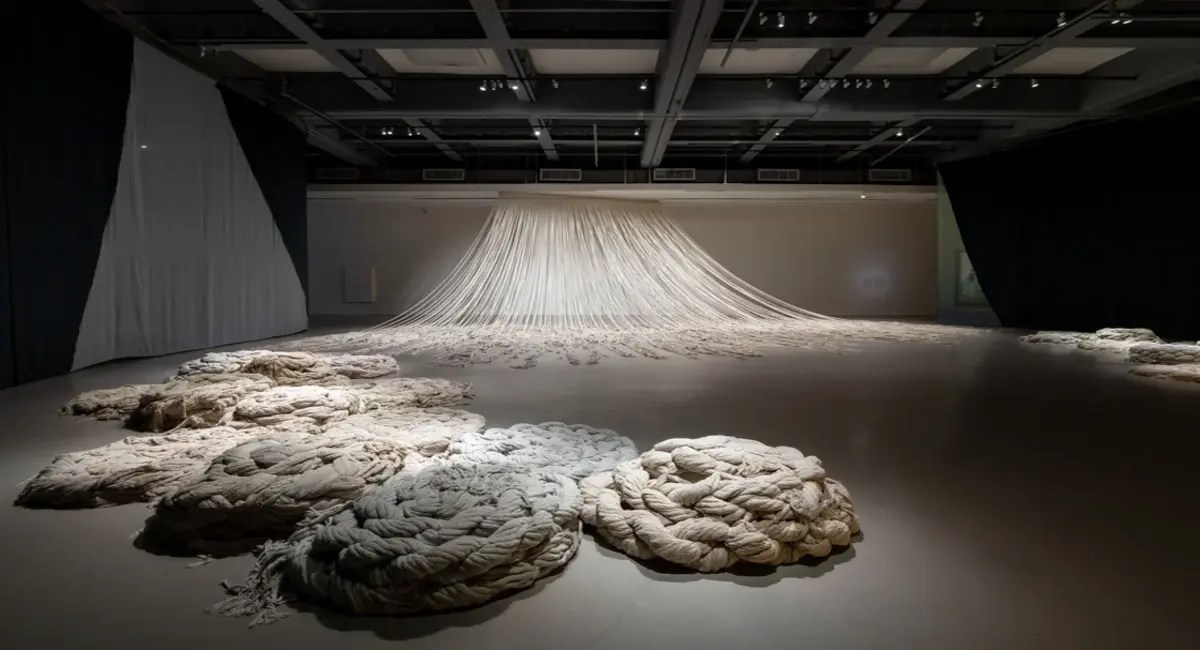
Installation view at ICD Brookfield Place, Dubai, UAE, 2021
IN/TANGIBLE INTIMACIES: Woven Archives, Woven Witnesses opened on November 11 at The Space, ICD Brookfield Place. Curated by Malak Qaoud, the exhibition brings together five artists: Afra AlDhaheri, Nour Hage, Aisha Alhammadi, Zainab M AlHashmi, and Chafa Ghaddar.
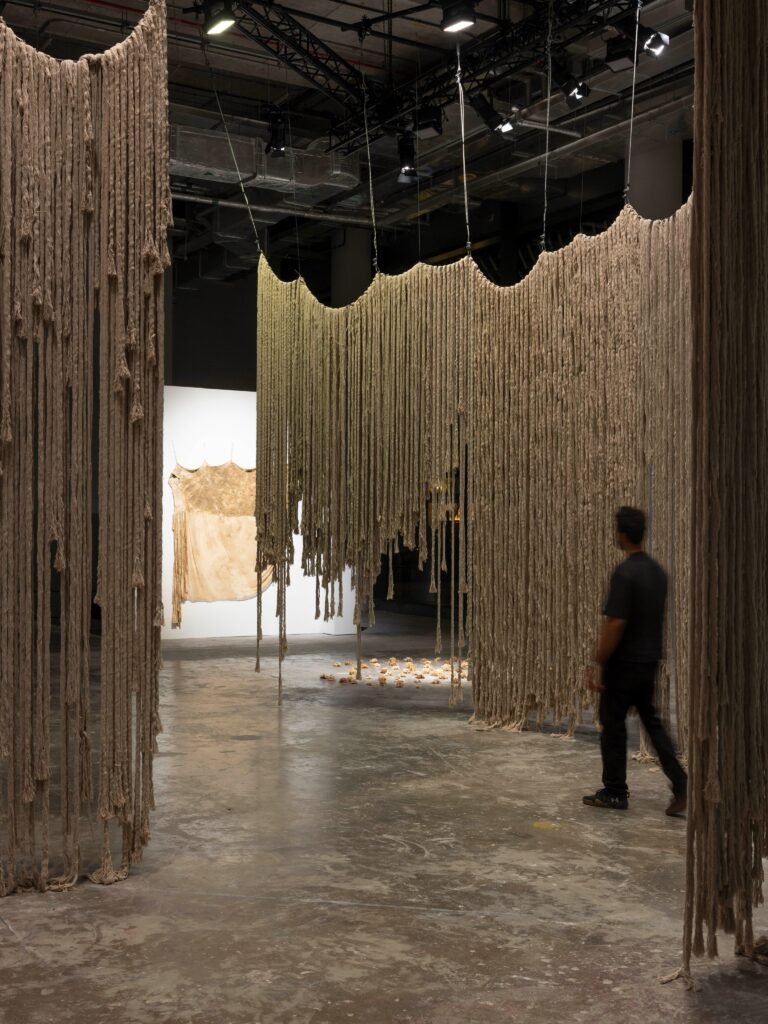
The exhibition approaches textiles and materials as repositories of personal, spiritual, and sociopolitical experience. Its works bring together fabrics, ropes, and marble slabs through weaving, pleating, and carving. Rather than treating these materials as passive objects, the artists explore what they can hold, communicate, and preserve.
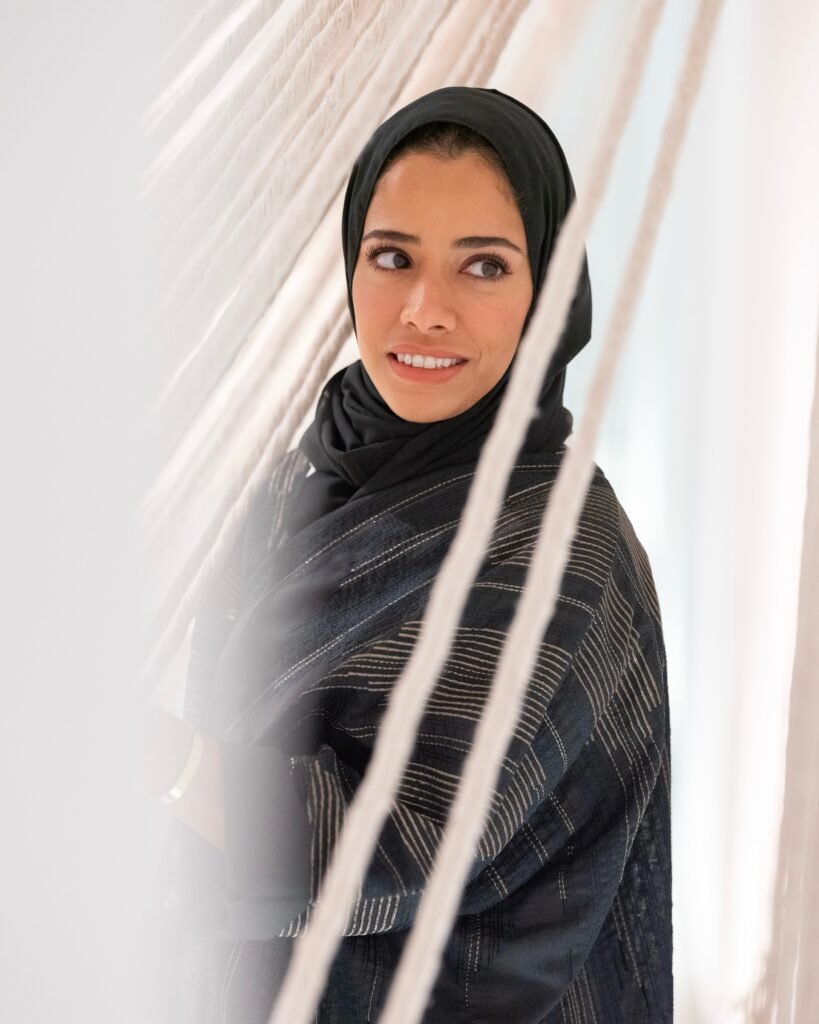
For Emirati artist Afra AlDhaheri, repetition and physical labour play an important role in the making process. Her practice combines cotton rope, fabric, cement, and other materials to examine time, tension, and transformation. In works such as Pull, Tie, Release (2024), knotted ropes stretch across a wooden frame. The work makes the gestures behind its construction visible, turning a simple sequence of actions into a reflection on endurance and release.
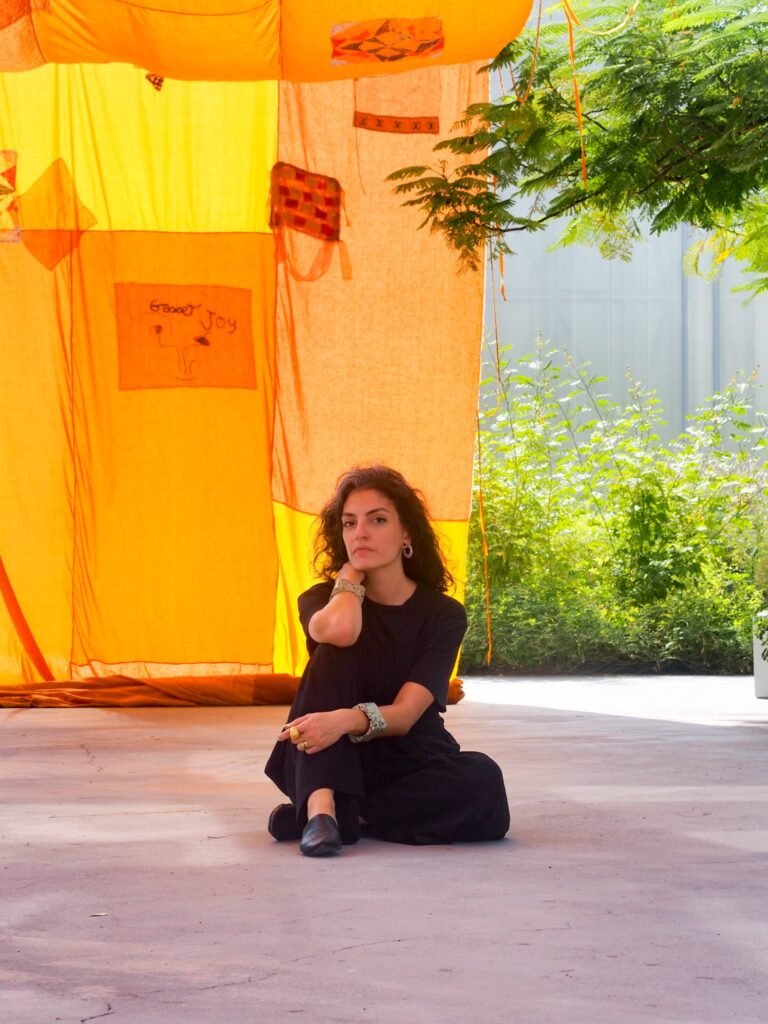
Lebanese-British artist Nour Hage approaches textiles through cultural memory and inherited knowledge. Working with hand-dyeing, weaving, and embroidery, she draws on West Asian folklore and Levantine traditions. Her practice explores womanhood, belonging, and the transmission of stories across generations.
Together, their approaches demonstrate how textile-based practices can move beyond decoration. They become ways of recording experiences that written archives may not fully capture.
Beyond the Boundaries of Craft
The conversation extends beyond Dubai. In Sharjah, Barjeel Art Foundation’s 2024 exhibition Women’s Work: From Craft to Fine Art, Reclaiming Arab Textile Art examined how modern and contemporary Arab women artists have redefined weaving and embroidery.
The exhibition brought together works spanning the 1950s to the 2020s. It explored how practices historically associated with domestic labour became forms of personal and social commentary. Among the featured artists, Stephanie Saade used embroidered references to her family home to explore memory and displacement. Bouchra Khalili combined cotton with magnetic tape in The Weaver, connecting textile traditions with the transmission of knowledge.
The exhibition also challenged a longstanding distinction between craft and fine art. For generations, weaving and embroidery carried cultural and practical value. Yet their association with domestic work often placed them outside established definitions of contemporary art.
These artists question that hierarchy. Their work positions material knowledge, repetition, and manual labour as meaningful artistic processes.
Tradition as a Living Language
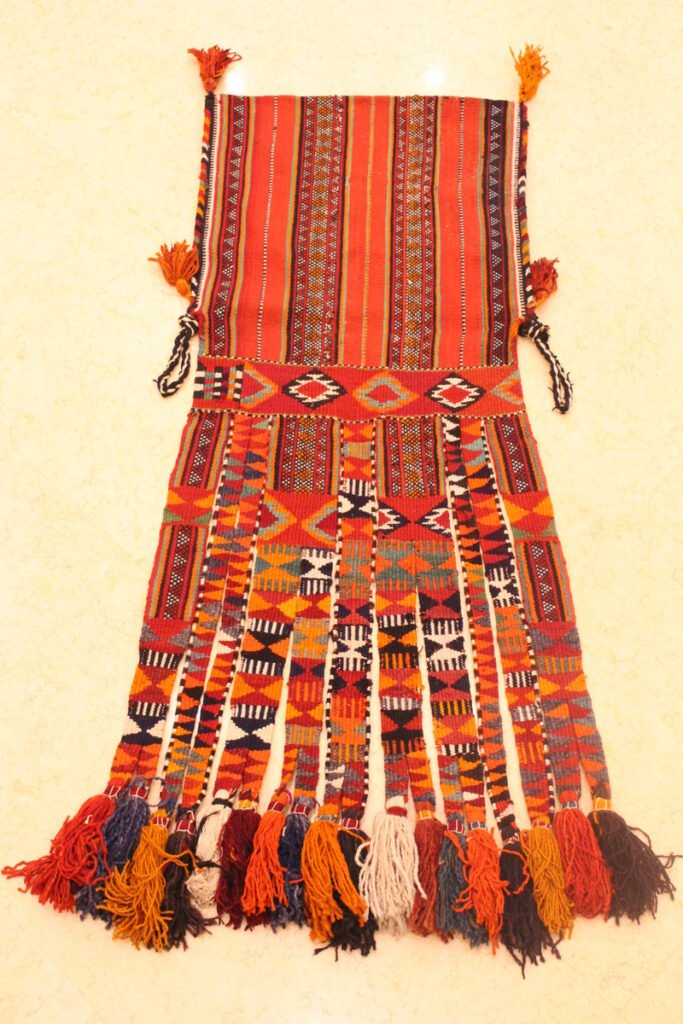
Contemporary textile art also creates new ways to engage with regional heritage. Kuwait’s AlSadu weaving tradition offers a compelling example.
Through the Sadu Art and Design Initiative, Kuwaiti artists have explored the technique alongside master weavers. The resulting exchange connects traditional knowledge with contemporary artistic experimentation.
The 2026 exhibition Beyond the Weave: Contemporary Dialogues with AlSadu, presented at the Middle East Institute in Washington, brought together 12 Kuwaiti artists. Their works translated the tradition’s geometric patterns and cultural references into different materials and formats.
Some artists retained the visual language of weaving, while others reinterpreted its structures through photography, digital design, and industrial materials. Abdulaziz AlRabea’s Tales in Stone, for instance, used 144 cement blocks imprinted with archival photographs from Kuwait and Egypt. The installation echoed the rhythmic geometry of Sadu patterns without reproducing the traditional technique itself.
This approach suggests that heritage does not need to remain fixed to remain meaningful. It can evolve through new materials, collaborations, and interpretations.
A Different Way of Seeing Material
Across these practices, textiles become more than references to the past. They offer artists a language for examining contemporary life, from personal identity and displacement to labour, social memory, and cultural change.
The growing presence of textile-based work in institutional exhibitions also reflects a broader reconsideration of what contemporary art can encompass. Materials once associated primarily with domestic or functional use now occupy spaces for artistic experimentation and critical discussion.
For Arab artists, this shift creates room to revisit inherited knowledge without being confined by it. A thread can become a record. A knot can express tension. A woven pattern can carry a history while suggesting something entirely new.
The result is not simply a return to traditional craft. It is a contemporary conversation about who creates, what materials remember, and how cultural knowledge continues to evolve.