
Rafa Nasiri was born in Tikrit in 1940, the same city and nearly the same year as several of the figures who would define Iraqi cultural life across the second half of the twentieth century. He grew up in a Baghdad that was becoming the intellectual and artistic capital of the Arab world, a city of organised art movements, published manifestoes, and an appetite for cultural experimentation that the region had rarely seen concentrated in a single place. Nasiri became one of the most important artists that environment produced, not because he was the most visible or the most politically dramatic, but because he built something institutional alongside something personal, and the two held together across a career that spanned five decades, three continents, and some of the most turbulent chapters in Iraqi and Arab history.
Baghdad to Beijing to Lisbon
Nasiri received a diploma in painting from the Institute of Fine Arts in Baghdad in 1959, before travelling to Beijing to study printmaking at the Central Academy of Fine Arts, a training trajectory that was, for an Iraqi artist of his generation, genuinely unusual. China in the early 1960s was not a conventional destination for Arab art students, and the exposure Nasiri received there left a permanent mark on everything he subsequently made. His exposure to Chinese art, specifically the ink paintings of Qi Baishi and the works of his teacher Huang Yu Yi, had a lasting impact on his exploration of calligraphic forms and words, an influence that connected directly to the Arabic script tradition he would later weave into his own visual language, creating a bridge between two ancient cultures of mark-making that nobody else in Iraqi art was building at the time.
In 1967, he received a scholarship from the Gulbenkian Foundation to study at the Gravura in Lisbon, between 1967 and 1969, adding a third formal printmaking education to his already substantial technical foundation, and exposing him to the European tradition of graphic arts at a moment when the field was undergoing significant experimentation. By the time he returned to Baghdad in 1969, he had studied printmaking on three continents and developed a technical range that was, within the Arab world, essentially without precedent.
The New Vision and What It Meant
After returning to Baghdad, Nasiri headed the graphics department at the Institute of Fine Arts and was a founding member of the New Vision Group alongside Dia Azzawi, Mohammed Muhriddin, Ismail Fattah, Hachem al-Samarchi, and Saleh al-Jumaie. We covered Dia Azzawi in this series, and the founding of New Vision was already described there in the context of the 1967 Arab-Israeli War. What Azzawi brought to the group was its political urgency and its visual drama. What Nasiri brought was something quieter and in its own way equally important: a rigorous commitment to printmaking as a serious artistic medium deserving the same intellectual attention as painting, and a teaching practice that would shape the next generation of Iraqi artists for the following two decades.
Nasiri founded and headed the printing workshop at the Institute of Fine Arts in Baghdad from 1974 until his retirement in 1989, fifteen years of building infrastructure, training students, and establishing printmaking as a legitimate field within Iraqi art education. The workshop he created was not simply a facility. It was an argument, made in institutional form, that the graphic arts deserved the same resources and seriousness that painting had always received. That argument took decades to fully win, and Nasiri made it consistently throughout his teaching career.
The Work and Its Language
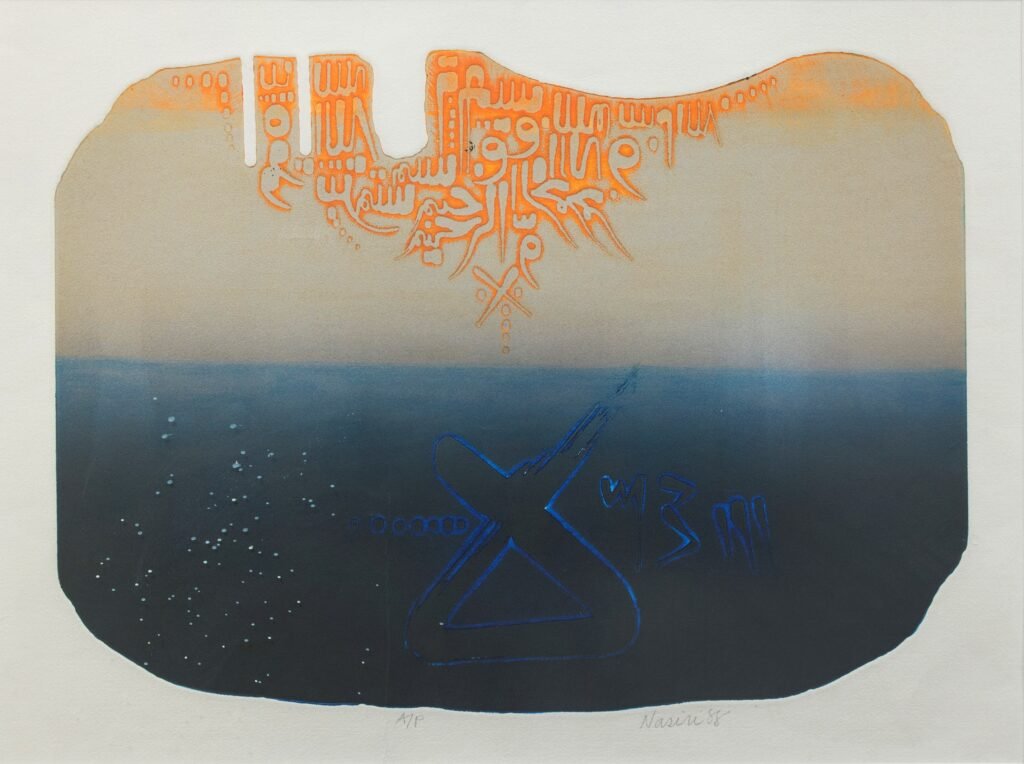
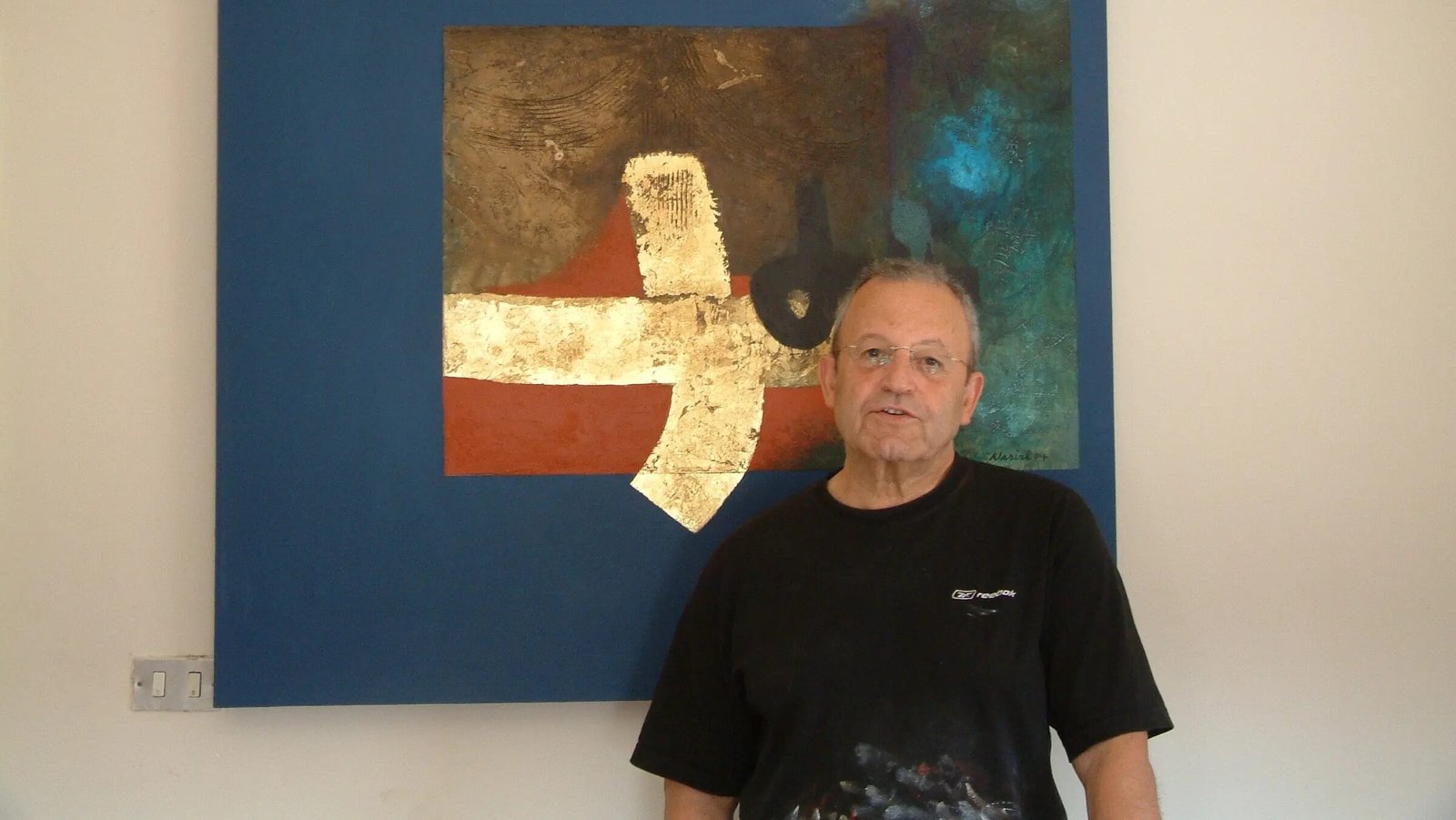
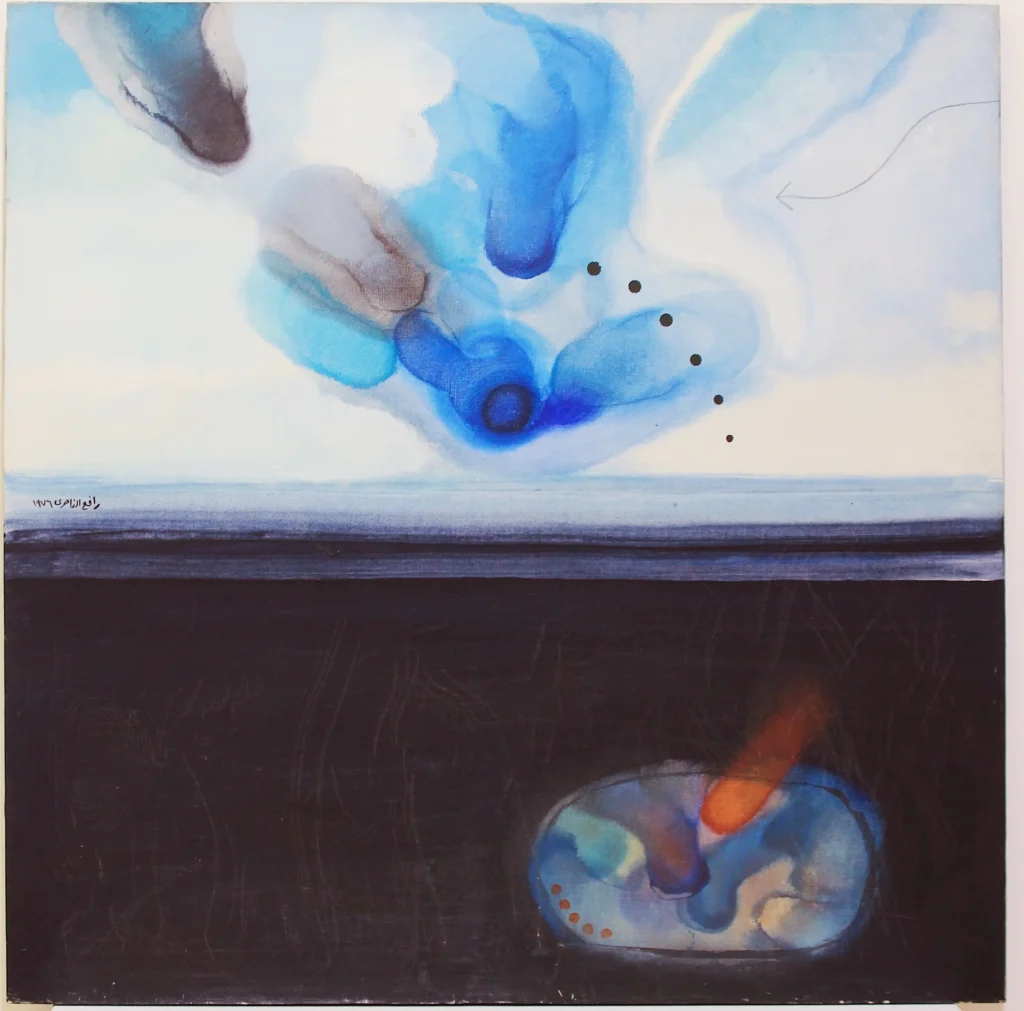
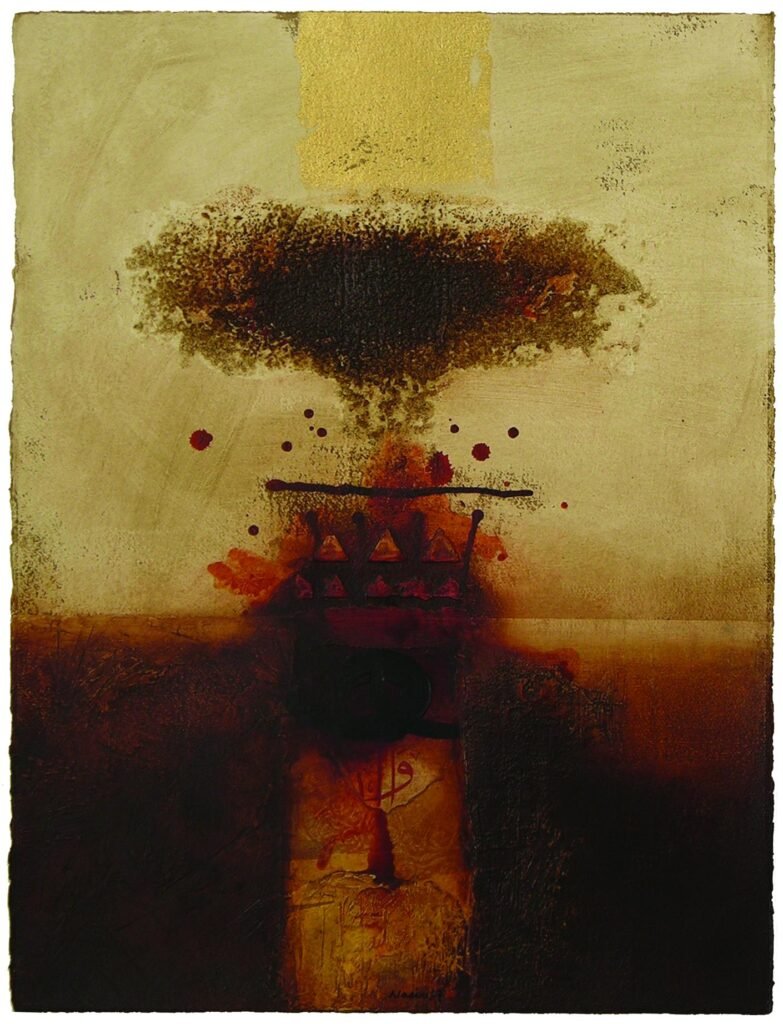
Influenced by the art of China, most prominently in the technique of ink drawing and the use of negative space, Nasiri brought together deeply saturated colours and fluid gestural lines to create all-encompassing spatial landscapes, which reflect the inner consciousness and his deep interest in poetry. Critics described his compositions as “cosmicscapes,” a term that captures something real about the scale of his visual ambition, the sense in his best work that the picture plane opens outward rather than closing inward. The Arabic calligraphic elements that run through his work are not decorative additions; they are structural components, carrying meaning through both their visual form and their literary content, connecting the image to the deep tradition of Arabic written culture in a way that was genuinely innovative rather than merely referential.
Nasiri was one of the forerunners of the art style known as hurufiyya, the Arab modernist movement that placed Arabic script at the centre of abstract composition, using letterforms as both visual and semantic elements simultaneously. His time in Beijing, learning from Chinese masters who had spent centuries treating calligraphy as the highest form of visual art, gave him a framework for understanding what Arabic script could do in a contemporary painting that most of his contemporaries were still working out from scratch.
Exile and the Later Work
In 1991, Nasiri accepted a position teaching painting, printmaking, and design at Yarmouk University in Irbid, Jordan, leaving Iraq as the country entered the long crisis that would define its next three decades. The departure was not simply professional. It was the beginning of an exile that shaped the final phase of his career. In Jordan, he set up a printmaking studio at Darat al Funun, delivered lectures on graphic art and Iraqi art, and engaged with other Arab artists and intellectuals visiting or based in Amman. The studio at Darat al Funun was a replication, in a different city, of the same institutional work he had done in Baghdad, building infrastructure, creating space for younger artists to work, making printmaking possible where it had not previously been.
In 1997, he moved to Bahrain to lecture at the University of Bahrain and direct the Bahrain Centre for the Fine Arts and Tradition, publishing his book Fann al-Grafik al-Mu’asir, Contemporary Graphic Art, that same year. The book was both a technical manual and a historical argument, the most comprehensive account of printmaking in the Arab world that had been produced up to that point, written by the person best qualified to write it.
Nasiri died in Amman on December 7th, 2013, having spent his final years in Jordan with his wife, the poet and critic May Muzaffar, who documented their life together in a memoir later published in English as Story of Water and Fire. His archive is held at NYU’s Arab Art Archive. His prints are in the collections of Mathaf in Doha, the Barjeel Art Foundation in Sharjah, and institutions across the Arab world. He was seventy-three years old, a full life, by any measure, and one spent almost entirely in the service of an art form that the Arab world has still not fully acknowledged as his work deserves.