
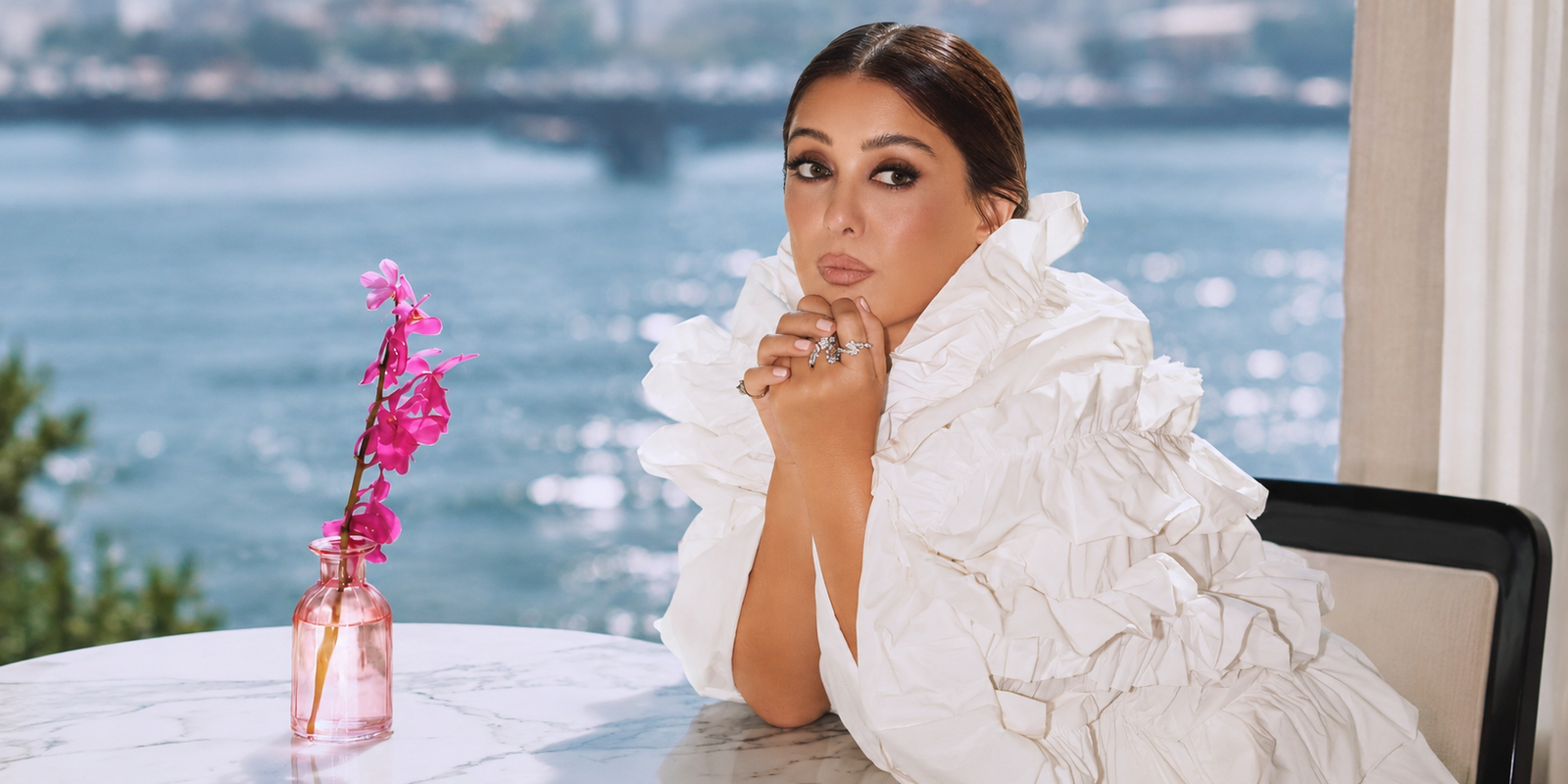
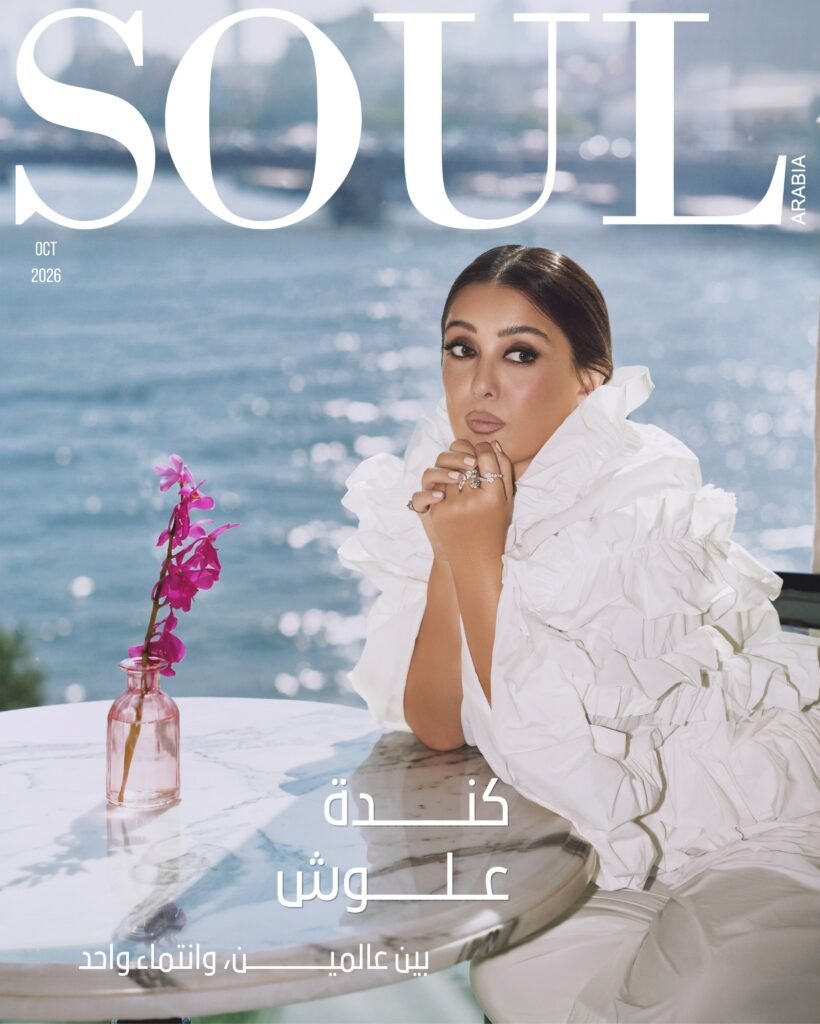
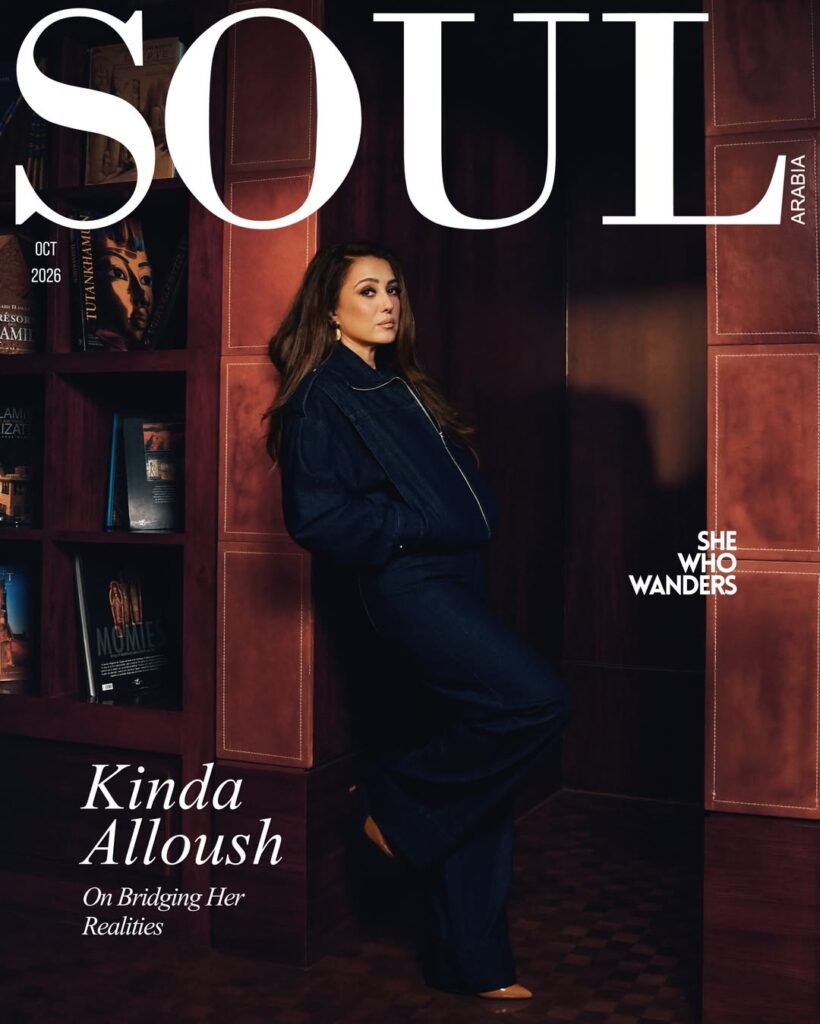
Between Syria and Egypt, motherhood and ambition, Kinda Alloush reflects on belonging, creative curiosity, and learning to embrace change.
For Alloush, curiosity begins with observing the world around her. She watches how people relate to one another and wonders why things happen as they do. Lately, she finds the world’s pace increasingly strange and difficult to understand.
“I like to know and understand why the world is running this way,” she says. Beyond her familiar screen presence, there remains a woman interested in discovering what lies beneath the surface.
Perhaps this is where She Who Wanders finds its meaning. Wandering does not always require a suitcase or an unfamiliar landscape. Sometimes, it begins with questioning what once felt certain.
For Alloush, change has come through countries, characters, relationships, and responsibilities. Each has added another dimension to her sense of self.
The Decision That Changed Everything
Years ago, Alloush faced a decision that seemed like another professional opportunity. She was living and working in Syria when a film with director Sherif Arafa came her way. The project was Awlad El-Aam, and she remembers feeling hesitant about accepting it.
At the time, she could not have imagined what that choice would mean. It would lead her toward Egypt, another professional landscape, and an entirely different life.
She has now spent approximately seventeen years living and working in Egypt. Her husband is Egyptian, and so are her children. Egypt has also become her second nationality.
Looking back, she sees that decision as one of her life’s most significant turning points. She calls it one of the loveliest changes her life has brought her. Sometimes, a decision reveals its meaning only after we have lived with its consequences.
Syria in Her Memory, Egypt in Her Present
For Alloush, belonging is not a question with only one answer. Syria holds her childhood and youth, including the formative years surrounding her studies. Egypt has become the setting for her maturity, family life, and present ambitions.
Her memories of Syria carry a particular longing. She misses places and the cultural atmosphere that shaped her early understanding of the world.
Egypt occupies a different emotional space. It represents the present and the future she is building with her family. Yet her connection to the country extends far beyond circumstance or residence.
“I adore Egyptian culture,” she explains. Her affection reaches into music, cinema, poetry, writing, and the country’s wider artistic heritage.
After arriving, she made a conscious effort to understand Egyptian society from within. She wanted to engage with its culture rather than simply live among its people. Over time, that engagement became part of her identity.
Friends recognise elements of her Syrian upbringing alongside traits they consider distinctly Egyptian. For Alloush, the identities do not compete. Syria shaped her beginnings, while Egypt shaped many decisions that followed. Together, they have shaped her work, relationships, motherhood, and understanding of herself.
Moving between cultures does not necessarily mean leaving one identity behind. It can mean discovering that identity has room to expand.
Home Is Where Her People Are
When asked what makes a place feel like home, Alloush recalls her arrival in Egypt. She remembers immediately feeling that it belonged to her.
Today, her answer centers on something more personal. Home has become inseparable from the presence of her family, including her husband, their two children, and her wider family.
“If my family is there, I’ll feel that this is my homeland,” she explains.
A place can carry history and cultural significance. Nevertheless, its deepest meaning often comes from the people who share our lives.
Entering Another Woman’s World
Acting offers Alloush a way to discover lives beyond her own. She has portrayed Arab women from several national backgrounds, including Syrian, Jordanian, Palestinian, and Egyptian characters. One recent film role also connected her to the Gulf.
For Alloush, unfamiliarity is often an invitation rather than an obstacle. The further a character stands from her own experience, the greater her curiosity becomes.
She points to her role in Ekhwaty as a particularly interesting challenge. The character came from a working-class environment unfamiliar to her. Her profession, surroundings, and relationships differed from Alloush’s own world.
The series blended realism with heightened storytelling. Its four siblings confronted a murder with awkwardly ordinary reactions and a comedic edge.
Rather than relying on instinct alone, Alloush studied the character’s environment, accent, appearance, clothing, hair, and makeup.
Her work in Sittat Beit El-Maadi and Afrah El-Qobba brought different challenges. Both were set in the 1950s, when people spoke and reacted within a calmer social atmosphere.
Performing a period character required more than historically appropriate clothing. It demanded an understanding of how time and circumstance influence behaviour. Research helps her approach each character’s emotional world with greater care.
When Art Approaches Another Person’s Pain
Alloush left Syria around the beginning of the war. Consequently, she did not experience the conflict directly as those who remained experienced it.
However, she later worked on Nezouh and The Swimmers. Both films explored the Syrian war and displacement. Nezouh won the Armani Beauty Audience Award at the 79th Venice International Film Festival. Meanwhile, The Swimmers earned director Sally El Hosaini the BAFTA Cymru Award for Director: Fiction.
These projects brought her closer to war and asylum, which she had previously understood from a distance.
Her previous humanitarian work had also brought her into contact with refugees. She had worked with the United Nations refugee agency, UNHCR, before these film experiences.
Nevertheless, acting in these stories affected her differently. She felt she had approached an experience she had not truly lived herself.
She remains careful about the limits of that understanding. A performance cannot reproduce the pain of someone who has experienced war or forced displacement. Yet the films deepened her empathy and reminded her that storytelling carries responsibilities.
Learning to Leave the Door Open
Alloush’s artistic interests began with directing. Her theatrical studies taught her how text, acting, and other elements combine to create a cohesive performance.
Later, her experience as an assistant director added another perspective. She began understanding the choices that shape a scene beyond the actor’s position.
That foundation still informs how she approaches a script. She considers whether its structure works and whether the writing feels cohesive. She also studies how a character’s world should be constructed.
Yet technical understanding is only one part of the process. Time has also taught her the value of flexibility.
When she was younger, she sometimes approached a role with a fixed vision. She knew what she wanted to achieve and could resist suggestions that challenged her original idea.
Gradually, she learned that an actor’s perspective alone cannot shape a complete performance. The director’s guidance matters, as does the energy brought by another performer.
She describes imagining a confrontation that involves shouting. Then, her scene partner might approach the same moment quietly. Suddenly, the conflict acquires a different emotional language.
Instead of insisting on her rehearsed interpretation, she can follow that possibility. What initially seemed familiar becomes something unexpected.
Her international productions strengthened this lesson. In Nezouh, Yellow Bus, and The Swimmers, she worked with artists from different nationalities and cinematic backgrounds. Their different methods taught her to adapt, and she remembers the immediate harmony she experienced with colleagues.
For her, this revealed something fundamental about cinema. People may approach their craft differently, but a genuine love of filmmaking can create common ground.
Ambition in a Different Shape
Ambition has always occupied an important place in Alloush’s life. Initially, she imagined directing as her profession. Later, acting became the focus of her career.
Her ambitions have consistently remained connected to art. Nevertheless, the intensity with which she pursues them has changed over time.
When she was younger, she was prepared to dedicate nearly all her time to professional goals. Motherhood altered that equation. Her attention could no longer belong entirely to her own ambitions.
Today, her daughter and son are part of how she understands success. Their achievements bring her satisfaction, reflecting the time she invests in them.
Her husband’s professional success also fulfils her. They share a profession, and she supports his creative development. His achievements can feel connected to her own artistic aspirations.
Her ambition has expanded beyond individual accomplishment into something shared. This does not mean she has stopped wanting to create. Rather, her priorities now occupy a broader emotional landscape.
Alloush describes periods of frequent work followed by stretches away from public view. After returning with Ekhwaty and, more recently, 50/50, she was reassured by the audience’s positive response.
These experiences have helped her feel comfortable with a less constant public presence. She does not believe every absence necessarily damages an artist’s relationship with an audience.
For Alloush, finding balance is increasingly important. Her children have grown, creating the possibility of dedicating more time to work. Still, she wants that renewed professional attention to coexist with her responsibilities at home.
She is not choosing between family and career. She is searching for a way to honor both.
Being Present for Something Beyond Herself
Alloush thinks carefully about the kind of presence she maintains in public. She wants to remain authentic in her speech, interviews, appearance, and choice of subjects.
She does not want to construct a life detached from who she actually is. Instead, she hopes her public presence can leave something positive behind.
This belief influences how she uses social media. She recognises that people may listen to public figures beyond their professional work. That visibility can become an opportunity to draw attention toward issues that matter.
Parenting is one subject close to her experience. Humanitarian activities, charitable work, and volunteering also hold personal importance.
She wants to amplify people whose voices might otherwise go unheard, encouraging support and highlighting overlooked issues.
She is not suggesting every public appearance must become serious or instructive. Fashion, travel, and lifestyle content can have their own place. However, she does not want those subjects to become the entire purpose of visibility.
For her, public influence carries a responsibility to offer something meaningful alongside personal expression.
Cairo, Aswan, and the Pleasure of Looking Again
Cairo holds a special position among the places that shaped Alloush’s life. The city represents one of the great changes in her personal and professional story.
She describes it as a place filled with almost everything imaginable. Art, civilisation, and history exist alongside crowded streets and quieter corners. Its energy offers different possibilities depending on what someone needs.
For Alloush, this variety is part of Cairo’s appeal. A single city can contain contrasting rhythms without forcing one to erase the other.
Aswan, however, holds a particularly intimate place in her heart. She had her wedding there and remains keen to return with her family. The Nile and the city’s rhythm continue to draw her back. She also expresses affection for Egypt’s southern destinations, especially Luxor and Aswan.
These places carry memories beyond their beauty, becoming part of her personal history.
Although she enjoys exploring alone, family life leaves less room for solitary experiences. She values observing a place without distractions, noticing its character, people, and quieter qualities.
Meanwhile, exploring Egypt with her children has created another source of pleasure. She wants them to know their country before travelling widely abroad.
They have visited Luxor, Aswan, Alexandria, the North Coast, El Gouna, Hurghada, and Fayoum. Through their eyes, familiar places become new again.
The Work Still Ahead
Despite the transformations that have shaped her life, Alloush does not feel finished with the artistic world.
She hopes to return to directing if time allows. She is also interested in production, particularly its creative dimensions rather than its financial responsibilities. Both possibilities represent areas she has not fully explored. She wants the time to study, prepare, and approach them thoughtfully.
These ambitions have waited alongside other responsibilities. Her children are growing, and she wants to accompany them through future changes. She knows the world offers children many competing influences, making attentiveness increasingly important.
Yet she also hopes the coming years will bring more balance. With her children older, she sees an opportunity to give greater attention to artistic work.
She does not want to return to the all-consuming ambition of her younger years. Instead, she hopes to make room for creative work without neglecting her role at home.
Making a Home in the Present
When asked what changes when someone measures life through personal growth rather than distance travelled, Alloush returns to the present.
She does not believe in spending too much time looking backward. Regret can become restrictive, but so can excessive nostalgia.
The past still has value; the distinction lies in learning from it without remaining there.
“The past should be good; you benefit from it, but you don’t sit living in it,” she reflects.
Similarly, she approaches the future without trying to calculate every possible outcome. Planning matters, but she believes the present deserves greater attention.
The world can change unexpectedly. Events beyond our control can rearrange even the most carefully constructed plans. Consequently, she prefers to build the present carefully.
She compares the present to laying the foundation of a home. What we establish now can support the years ahead.
For Kinda Alloush, the compass does not point toward a single final destination. It points toward the present, where family, art, and discovery can continue finding their balance.
Perhaps wandering means allowing experience to challenge familiar assumptions without demanding immediate answers. Between memory and possibility, Kinda Alloush keeps evolving.