
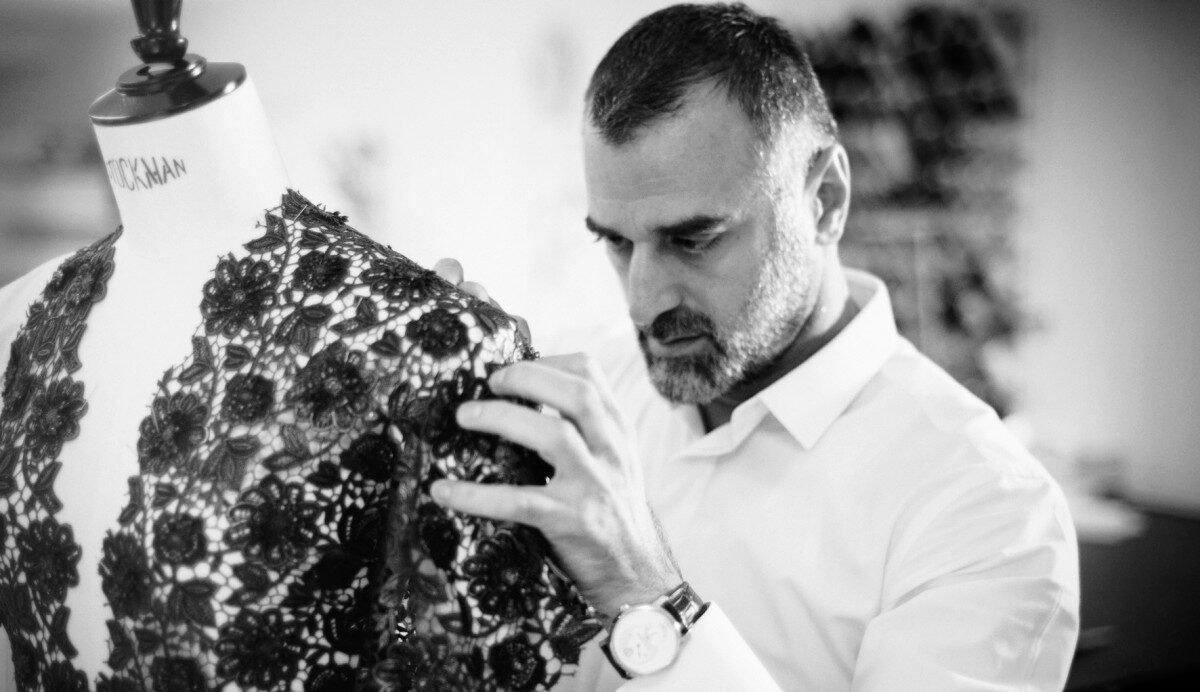
Georges Hobeika was not supposed to be a fashion designer. He was trained as a civil engineer, studied architectural design, and was on a path that had nothing to do with couture, until Lebanon’s civil war made that path impossible. The disruptions of the Lebanese Civil War, which upended his initial professional aspirations, prompted a search for creative expression amid the country’s recovery. What followed was a pivot that, in hindsight, looks inevitable. His architectural training, the understanding of structure, proportion, and form, never left him. It simply found a different material to work with.
The Beginning: Baskinta to Beirut to Paris
Hobeika was born in Baskinta, a village in the mountains of Lebanon, and was one of eight siblings. His mother, Marie, was a seamstress who ran her own boutique atelier, and from early childhood, Hobeika moved between her workroom and his textbooks, two worlds that would eventually collapse into one. When the war forced him out of Lebanon, he went to Paris, not as a student but as someone who needed to learn fast. He worked as an intern for several Parisian fashion houses, including Chanel. He did not stay in Paris. He took what Paris could teach him, and he brought it home.
In 1995, Georges Hobeika opened his first atelier in Beirut. Around that time, his mother closed her own boutique and referred all of her clients to him. They worked together to establish the fashion label. That detail matters. This was not a brand funded by investors or built on borrowed capital. It was a family operation, rooted in craft, built gradually and entirely on its own terms. Hobeika has since remained the sole shareholder of Georges Hobeika, having chosen to grow his brand slowly rather than quickly, a decision he credits for allowing the house to expand organically.
The Paris Move and What It Changed
In 2001, Hobeika had his first show in Paris at Hotel K. He has shown his couture collections at every biannual Paris Couture Fashion Week since. The world began to notice. The Arab Gulf had already known his name; Hobeika had designed clothing for royal families in Saudi Arabia, Qatar, and Kuwait, but Paris gave him international visibility of a different kind. In 2010, he opened a showroom on the prestigious Rue Royale in Paris. By 2017, the house had earned something that few regional designers have ever achieved: Maison Georges Hobeika was named an elected Guest Member of La Chambre Syndicale de la Haute Couture. That is the official body that governs Paris couture. Membership is not given easily, and it is not given quickly. It took Hobeika over two decades of consistent, serious work to earn it.
The Moment That Made the World Look
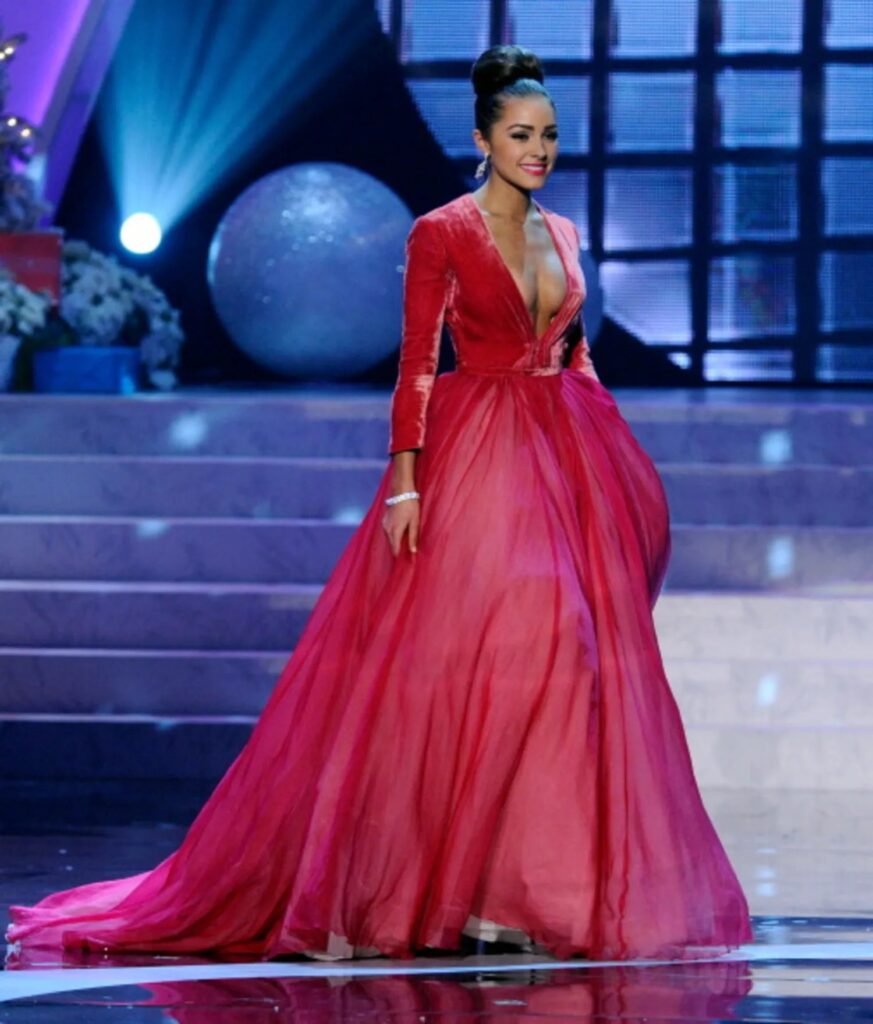
Every great fashion house has a single moment that breaks through the noise and reaches a mass audience that would not otherwise know the name. For Georges Hobeika, that moment came on December 19, 2012. Olivia Culpo was crowned Miss Universe 2012, wearing a Georges Hobeika gown for the final evening gown segment, the first time a couture gown that had debuted during Paris Couture Week was worn in the competition. It was a red gown. It was seen by hundreds of millions of people. And it announced, in one image, that a Lebanese designer based in Beirut was competing at the very highest level of international fashion.
The celebrity roster that followed tells its own story. Beyoncé, Jennifer Lopez, Priyanka Chopra, Aishwarya Rai, Adele, Cardi B, Monica Bellucci, Lily Collins, the list covers Hollywood, Bollywood, pop music, and the red carpets of Cannes, Venice, and the Academy Awards. The main atelier in Beirut now employs more than 150 people across all the skills required for a couture house, from embroiderers to tailors. Every stitch, every motif, every embroidery is designed and executed in-house, a rarity even among established European maisons.
Baalbek and the Statement It Made
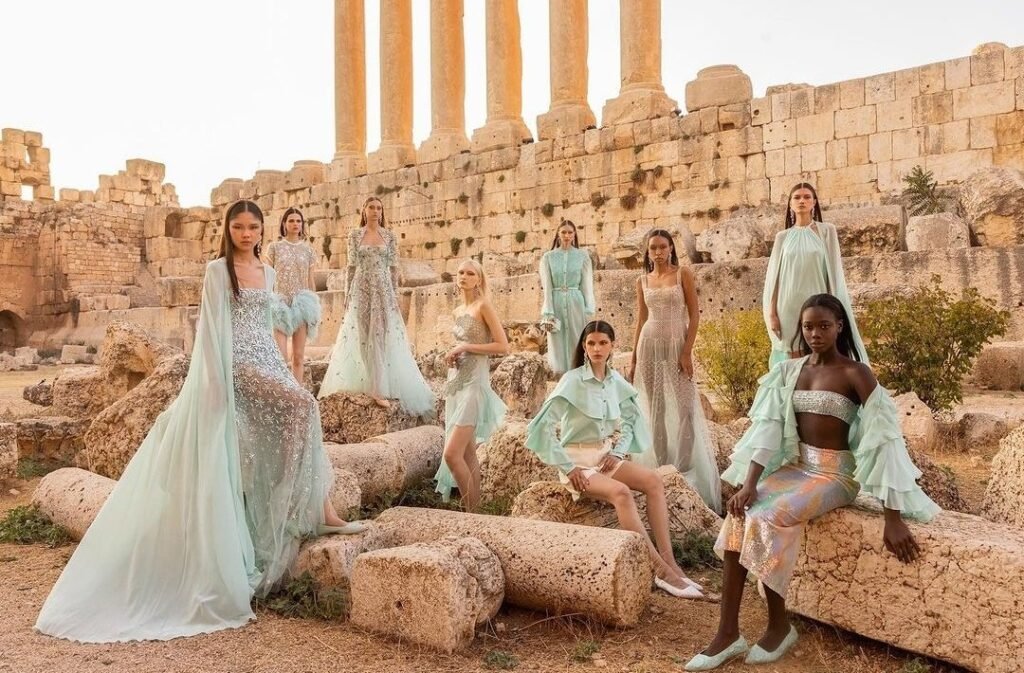
In September 2023, the house did something that had never been done before. Maison Georges Hobeika became the first fashion house to stage a show at the ancient Temple of Baalbek in Lebanon, a UNESCO World Heritage site, presenting its prêt-à-porter collection titled “Goddess of Love” in collaboration with the Lebanese Ministry of Culture.The collection, inspired by Aphrodite and Botticelli’s Birth of Venus, was streamed during Paris Fashion Week and reached a global audience simultaneously. A portion of the proceeds supported the Children’s Cancer Center in Lebanon. It was not just a runway show. It was a declaration that Lebanon’s heritage is worth celebrating, that Lebanese fashion belongs on the world stage, and that the two do not have to be separated.
The Next Chapter

In 2022, Jad Hobeika, Georges’s son, was unveiled as Co-Creative Director of the fashion house. He trained at the École de la Chambre Syndicale de la Couture Parisienne, the same institution whose traditions his father built a career upon. The handover is not a retirement. It is a continuation, the same house, the same standards, now carrying a second generation’s perspective alongside the first. In December 2022, the house unveiled a pop-up boutique at Harrods, followed by a permanent concession in January 2023.The expansion is real, and it is moving at the pace Hobeika has always preferred: deliberately, without noise, one step at a time.
Why It Belongs in The Brand File
Georges Hobeika is the most direct answer available to anyone who asks whether a Middle Eastern fashion house can build genuine, lasting global relevance without compromising what it is. The answer, built over thirty years in Beirut and Paris, is yes, if you are patient, if you are precise, and if you never hand the keys to anyone else.