
Arab fashion has never been short on creativity. Today, its designers are proving that creativity can also build businesses with international reach.
From sculptural heels and intricate couture to contemporary jewelry, Arab-founded labels are finding audiences far beyond the region. Their success stories are not simply about dressing celebrities or appearing on international runways. They are about building recognizable identities, protecting craftsmanship, and turning a creative vision into a lasting business.
Some have established their names in Paris. Others have taken their heritage to international retailers and new markets. What connects them is a clear point of view and the ambition to build something that travels.
Here are six Arab fashion entrepreneurs putting their names on the global fashion map.
Amina Muaddi: Making a Signature Heel Impossible to Miss

Amina Muaddi understood the power of a recognizable design long before launching her namesake label. The Jordanian-Romanian designer built her career across fashion capitals, from Milan to New York and Paris. Her experience included styling work and an early footwear venture, Oscar Tiye.
In 2018, she launched her own luxury footwear brand. Its sculptural heels, distinctive fluted shapes, and bold silhouettes quickly became recognizable. The label’s first collection reached major retailers, including Bergdorf Goodman, Net-a-Porter, and Harrods.
Her collaboration with Rihanna‘s Fenty further expanded her international visibility. It also introduced her design language to an even wider audience. Since then, the brand has grown beyond footwear into handbags and jewelry.
Muaddi’s success shows the value of building a signature product. Rather than chasing every trend, she created a silhouette that customers could identify instantly. That kind of recognition gives a luxury label a stronger identity in an increasingly crowded market.
Mohammed Ashi: Taking Saudi Couture to Paris
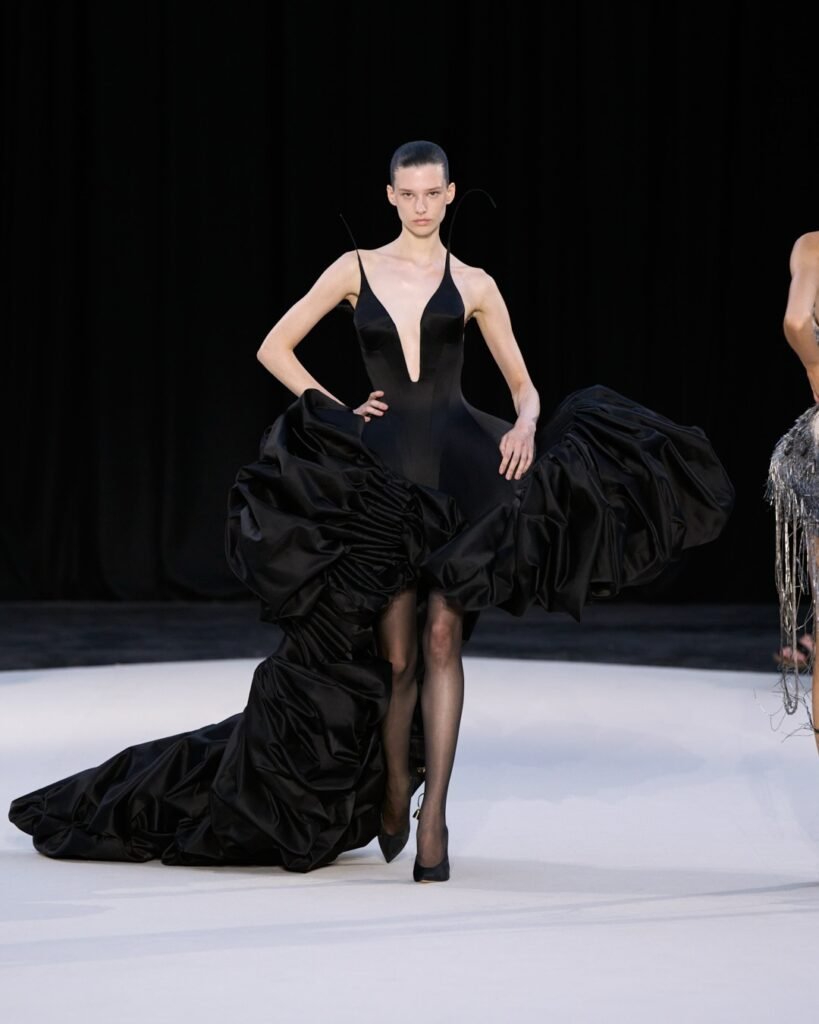
Saudi designer Mohammed Ashi has built a fashion house that speaks the language of international couture. He founded Ashi Studio in Beirut in 2007 before relocating its headquarters to Paris in 2018.
His work is known for dramatic proportions, sculptural construction, and intricate detailing. The label has dressed influential figures, including Queen Rania of Jordan, Beyoncé, Lady Gaga, and Kylie Jenner.

Ashi’s career also marked an important milestone for Arab fashion. In July 2023, he became the first Saudi designer to present on the official Paris Haute Couture Week calendar. He also became the first Gulf designer admitted as a guest member of the Fédération de la Haute Couture et de la Mode.
These achievements represent more than a personal breakthrough. They place Saudi design within one of fashion’s most established institutions. Ashi Studio demonstrates how a regional creative identity can compete at the highest level of luxury fashion.
Sandra Mansour: Turning Artistic Storytelling Into a Fashion House

Lebanese designer Sandra Mansour approaches fashion through art, emotion, and craftsmanship. She founded her namesake label in Beirut in 2010. Its collections combine delicate fabrics, intricate embroidery, and feminine silhouettes.
Her work has gradually reached audiences across Europe, the United States, and China. One of her most notable milestones came in 2020, when she collaborated with H&M on the Fleur du Soleil collection. The partnership introduced her aesthetic to a much wider international audience.
Mansour’s designs have also appeared on international red carpets. Sarah Jessica Parker and Gigi Hadid are among the names who have worn her creations.
Her journey highlights a different route to global recognition. Rather than abandoning her artistic language, Mansour has built a brand around it. Her work makes a strong case for craftsmanship and storytelling as lasting business assets.
Rami Kadi: Where Couture Meets Experimentation

Lebanese-American designer Rami Kadi founded his Beirut-based maison in 2011. Since then, he has developed a couture identity built around bold color, elaborate embellishment, and experimental materials.
The maison began presenting collections during Paris fashion events in 2014. It later staged its first Paris Fashion Week show in January 2019. His creations have since appeared at major international events and on celebrities such as Beyoncé and Salma Hayek.
But Kadi’s ambitions extend beyond traditional couture. His Spring/Summer 2020 collection featured a dress made from recycled plastic. The collection also formed part of a cyber-fashion show exploring fashion and environmental change.
In 2022, the maison launched Lucid Algorithms, an NFT project that brought couture into the digital space. Kadi has continued exploring the relationship between fashion, technology, and art.
His approach shows that heritage and innovation do not have to compete. A couture house can preserve handcraft while experimenting with new materials and platforms.
AZZI & OSTA: A Lebanese Duo With a Global Couture Following

George Azzi and Assaad Osta built their fashion partnership on a shared education and creative vision. The Lebanese designers met at ESMOD Beirut in 2004. After graduating, they joined Elie Saab’s design studio, where they worked closely with the couturier.
In 2010, they launched their own fashion house, AZZI & OSTA. The label has since expanded across haute couture, bridalwear, and ready-to-wear.
Their designs balance architectural structure with intricate detailing. The duo has dressed an international roster of women, including Taylor Swift and Kendall Jenner.
The brand’s collections reach markets across Europe, Asia, the Gulf, and the United States. Its international presence reflects the founders’ ability to translate a distinctive design language into several fashion categories.
AZZI & OSTA also offers an example of creative partnership as a business model. Two complementary perspectives have helped create a recognizable label with a clear identity.
Azza Fahmy Jewellery: A Family Business With an International Vision

Few Arab fashion stories demonstrate the power of heritage quite like Azza Fahmy Jewellery. Founded in Egypt in 1969, the brand grew from Azza Fahmy’s fascination with jewelry history and traditional craftsmanship.
Fahmy learned the trade in Cairo’s Khan El Khalili district. She later pursued formal jewelry training in London. Her work brought together Egyptian heritage, historical references, and contemporary design.
Today, her daughters play central roles in the company’s next chapter. Fatma Ghali serves as CEO, while Amina Ghali leads design. Together, they have helped develop the family business into an international luxury design house.
The brand’s collections reach customers across the Middle East and international markets. Its pieces have also attracted high-profile admirers, including Bella Hadid and Julia Roberts.
What makes this story particularly compelling is its balance between continuity and growth. The brand continues to draw on its founder’s original vision. At the same time, its next generation is expanding its commercial reach and creative possibilities.
A New Chapter for Arab Fashion
These entrepreneurs do not share one aesthetic, business model, or route to success. Some have built their names through couture. Others have found opportunities in accessories, ready-to-wear, or jewelry.
Yet their stories point to something bigger. Arab fashion is no longer defined only by regional recognition or occasional international appearances. Its designers and business leaders are building labels with distinct identities and wider ambitions.
Their success also challenges the idea that global luxury must follow a single geographic center. A brand can grow from Beirut, Cairo, or a designer’s personal journey across several countries. It can still find its place on the international stage.
The next chapter will depend on more than creative talent. Strong business foundations, skilled production, international distribution, and the ability to evolve will matter just as much.
For these entrepreneurs, the ambition is not simply to be seen by the world. It is to build brands that the world remembers.