
There is something deliberate about the way Tiffany & Co. moves through the world. It does not chase trends. It does not crowd its calendar. Once a year, it reveals its Blue Book collection, the house’s highest expression of jewellery-making, a tradition that has been running for over a century, and the industry stops to pay attention. This year’s edition is called Hidden Garden, and it is, without question, one of the most layered and beautiful things the house has produced in recent memory.
The Creative Vision Behind It
Blue Book 2026: Hidden Garden was conceived by Nathalie Verdeille, Senior Vice President and Chief Artistic Officer, in collaboration with the Tiffany Design Studio. The collection traces the subtle evolution of flora and fauna through sculptural compositions and exceptionally matched gemstones. Verdeille has been at the creative helm of the house since 2021, and with each Blue Book edition, she has pushed slightly further, first into the celestial, then into the ocean depths, and now, firmly, into the earth itself. After looking to the skies and diving into the depths of the sea, Tiffany has returned to earth for this newest collection, exploring nature through its quiet transformations.
What makes Verdeille’s approach worth paying attention to is that she does not simply borrow from the archive. She studies it until she can move past it. As she herself put it: “Over time, my relationship with Schlumberger’s legacy has become less literal. It was by studying his drawings, his creations, and his mechanisms in depth that I was gradually able to detach myself from them, retaining only the essence. It’s an energy and mindset that still has a Schlumberger-esque tone but is entirely my own.” That is an honest and rare thing for a creative director to say about a house as storied as this one.
The Legacy of Jean Schlumberger
To understand Hidden Garden, you need to understand the man it draws from. In 1956, Tiffany chairman Walter Hoving discovered the self-taught French-born jewellery designer and brought him on board as Vice President. Until his retirement in the late 1970s, Schlumberger conceived of diamond birds soaring through the sky and glittering butterflies landing on delicate floral vines and leaves. His inspiration was always firmly rooted in nature, with motifs that feel as organic as diamonds themselves. He did not design jewellery so much as he animated it, and Hidden Garden continues that tradition, piece by extraordinary piece.
The Ten Stories of the Collection
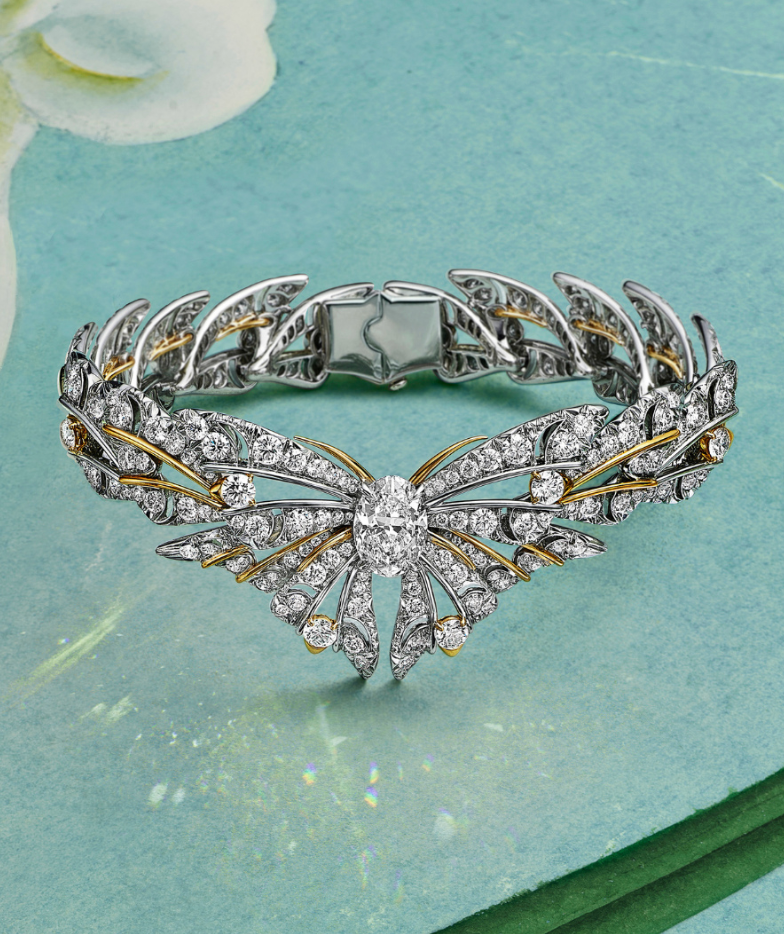
The collection opens with Butterfly, both abstract representations and realistic winged creatures rendered in Fancy Vivid Yellow diamonds and white oval-shaped diamonds. Echoing the fragile, ephemeral beauty of wings and the theme of metamorphosis and rebirth, select pendants are detachable and can be worn as brooches, reflecting the house’s enduring tradition of transformable design. The Monarch chapter continues the story: inspired by a Schlumberger original, the butterfly here is hidden among a series of vines and leaves, made in platinum and 18-karat yellow gold with pavé diamonds and cushion-cut Sri Lankan and Madagascar sapphires, making it a truly special piece.
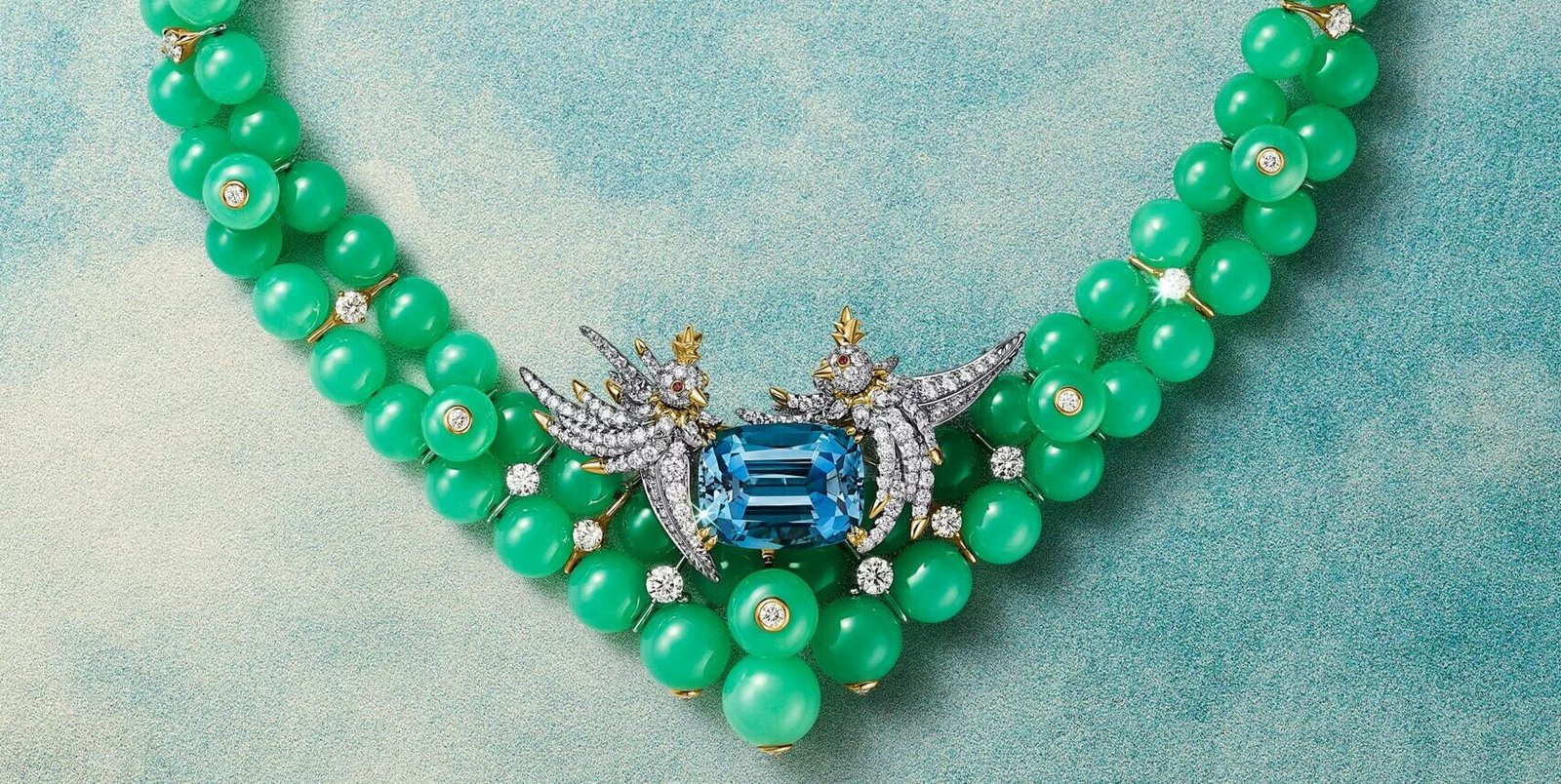
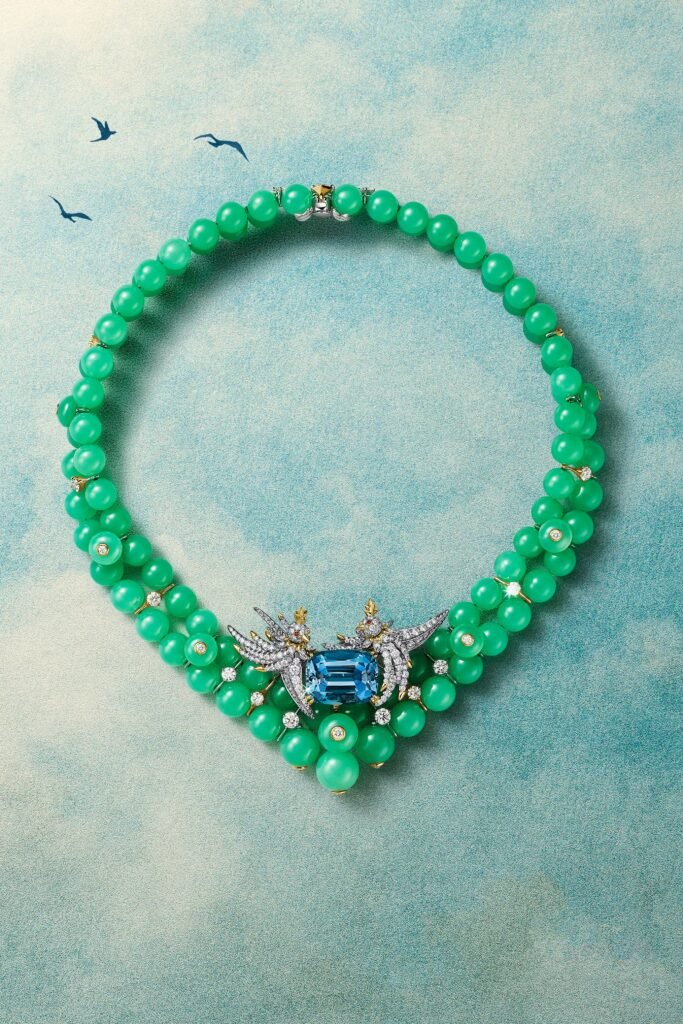
Then come the birds. Bird on a Rock, one of the house’s most recognisable designs, appears anchored by richly saturated stones, including aquamarines and chrysoprase, reinforcing the interplay between singular gemstones and sculptural form. The standout is a transformable necklace featuring an over-22-carat cushion-cut Santa Maria-hued aquamarine from Brazil, with custom-cut chrysoprase beads in bright green acting as its backdrop. The Parrot story is a callback to the fantastical parrot brooches Schlumberger created in the 1960s, enhanced by blue and purple sapphires that punctuate a whimsical mosaic of feather motifs, while diamonds are paired with exceptional paillonné enamel in a painterly palette of dark blue, duck green, and Tiffany Blue, hand-applied with extraordinary precision.
Where there are birds, there are bees. Schlumberger’s Two Bees ring serves as source material for the Bee story, resulting in a series of honeycomb-inspired lattices interspersed with oval diamonds; one ring featuring a 10-carat diamond is flanked by hidden figural bees.
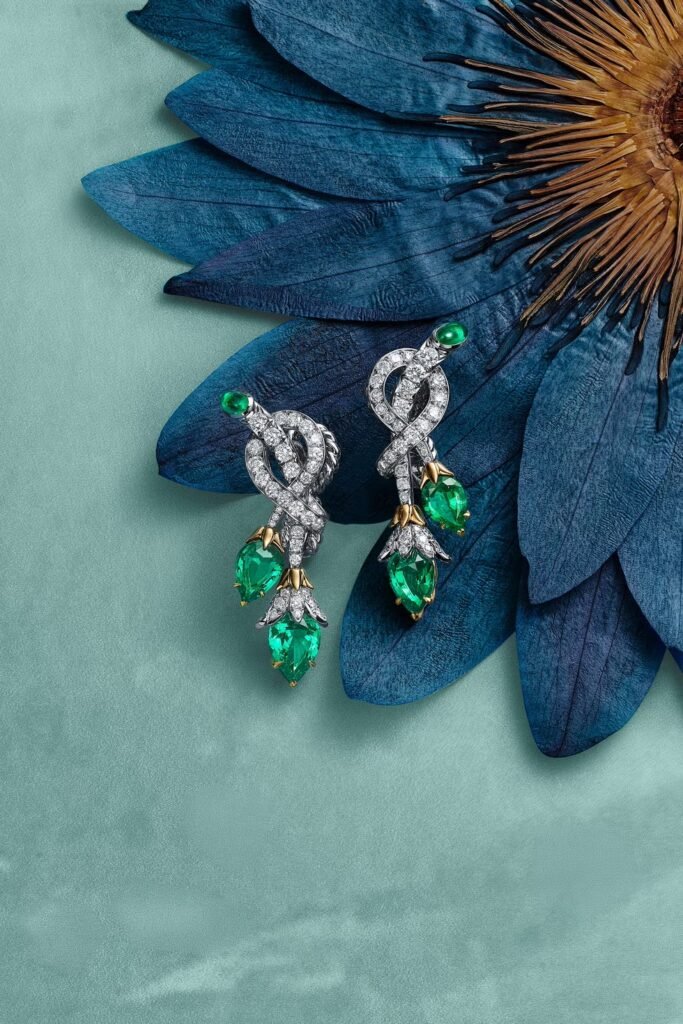
The final five stories belong to flowers. Jasmine, Marguerite, and Bloom translate archival motifs into intricate platinum braiding, sculpted petals, and radiant sapphires. Marguerite renders daisies in platinum with pink sapphires and emerald-cut diamonds, the embodiment of spring. Bloom refers to the moment before a flower unfurls, using pink and purple sapphires and 18-karat yellow gold. The collection closes with Twin Bud and Palm, where emeralds, rubies, and diamonds trace sinuous, light-catching paths, culminating in a study of balance between structure and spontaneity.
The Gemstones That Make It Possible
A collection like this does not come together without a gemological operation running in parallel. Tiffany’s chief gemologist, Victoria Reynolds, and her team scoured the world and presented the stones following an almost six-month journey. Reynolds described the process as being taken inside Verdeille’s head, what she was looking for from a colour standpoint and a texture standpoint. “This one sent our minds to Guadeloupe, it brought us into the forest,” she said. The pear-shaped emeralds used in Twin Bud came from Zambia, described simply as beautiful, very clean material.
A First Look That Arrived at the Oscars
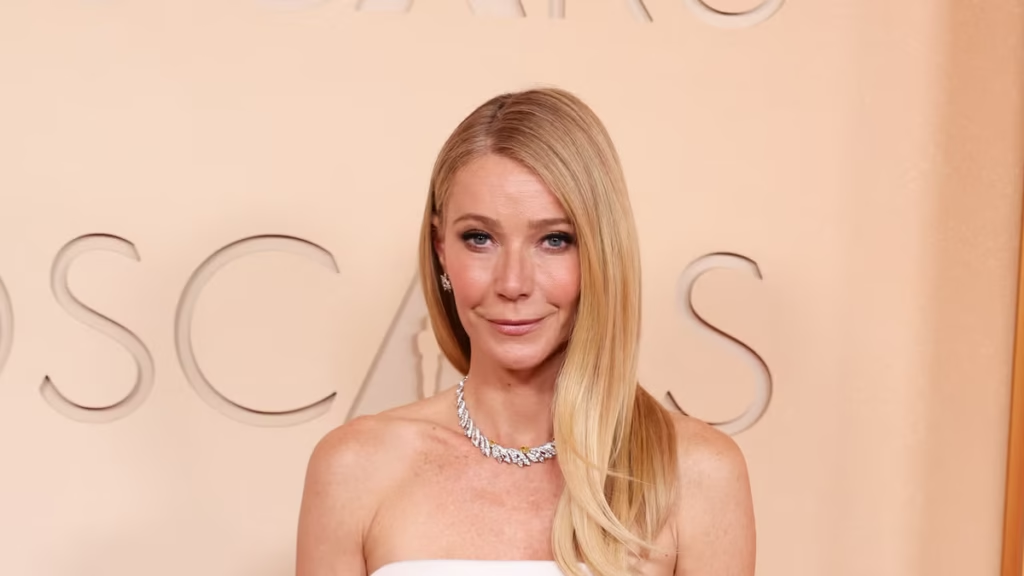
The world got its first glimpse of the collection before it was officially unveiled. Gwyneth Paltrow gave the first public preview at the 2026 Oscars, wearing a one-of-a-kind platinum and 18-karat yellow gold necklace featuring three oval-shaped Fancy Vivid Yellow diamonds against her sleek, strapless ivory silk Armani Privé gown. It was the kind of moment the house describes as the intersection of two worlds dedicated to excellence, and it worked.
What Comes Next
Hidden Garden is not a single chapter. The next two waves will debut in Hong Kong in June for summer, and close out the year with the final pieces debuting in Venice in September for autumn. Three cities, three seasons, one continuous narrative. The garden, it seems, is still growing.
For those of us in this region who watch the jewellery world closely, Hidden Garden is a reminder of what high jewellery looks like at its most purposeful, when heritage is not a burden but a starting point, when gemstones are not decoration but the entire argument, and when the person holding the creative pen knows exactly how much pressure to apply and when to let the stones speak for themselves. Tiffany has been doing this for over 180 years. Hidden Garden proves they have not lost the instinct.