
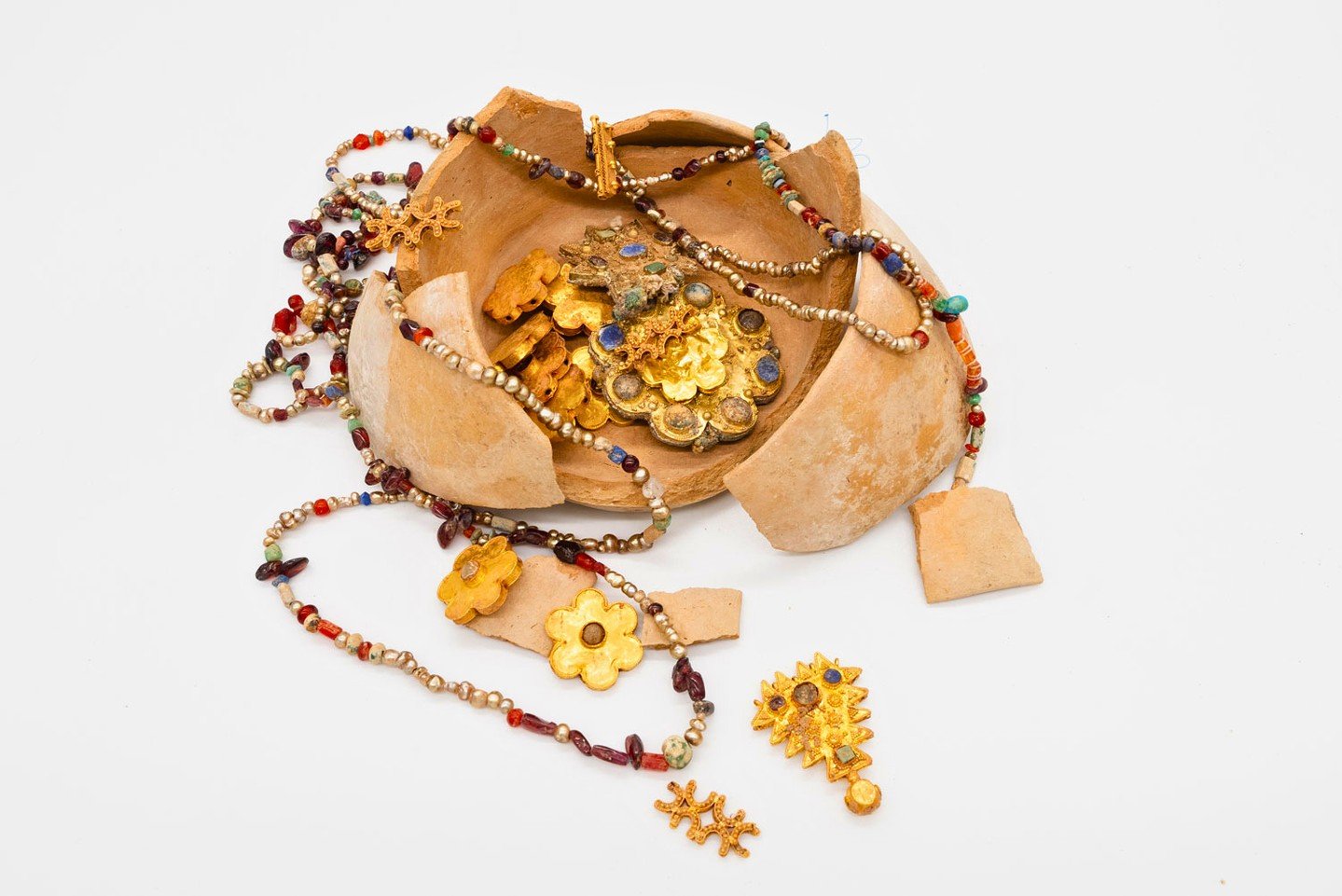
During the fourth season of excavation at the ancient site of Dariyah in Saudi Arabia’s Al-Qassim region, the Saudi Heritage Commission unearthed what appears to be a complete, matching adornment set, 100 gold jewellery pieces dating back over 1,100 years to the Abbasid era. The pieces were lying beneath the ground, intact, for over a millennium. Researchers still do not know who owned the jewellery or why such an elaborate collection was left behind. That question, unanswered, possibly unanswerable, is part of what makes the discovery so striking.
What the Pieces Look Like
The collection includes pendants, decorated discs, multi-coloured beads, and delicate gold spacers, likely once strung together as necklaces or ceremonial jewellery. The motifs are floral and geometric, and one piece stands out above the rest: a large disc-shaped ornament inlaid with coloured stones arranged symmetrically around a central design. Every piece was produced by hand, gold sheets hammered and shaped, patterns pressed into the surface, stones placed individually into prepared settings. The craftsmanship is not incidental. It is the clearest evidence of how sophisticated Abbasid-era goldsmithing actually was, not as a historical claim, but as a physical fact you can hold.
The coloured stones embedded throughout the collection hint directly at the trade networks the region sat within. Goods and materials moved constantly along these routes, linking distant regions through exchange. Whoever owned this jewellery had access to materials that came from far away.
Where It Was Found and Why It Matters
Dariyah stood along the Basran Hajj route, the ancient corridor that pilgrims from Iraq used on their way to Mecca, which made it a natural stopping point for travellers, merchants, and settlers alike. The excavation also uncovered stone building foundations, fire hearths, mud walls, and plastered rooms, alongside pottery, glass fragments, and metal tools, confirming that people lived here permanently, not just passed through.
One hundred gold pieces, eleven centuries underground, on a route that once connected the world. The Arabian Peninsula was never a margin of history. This find is proof.