
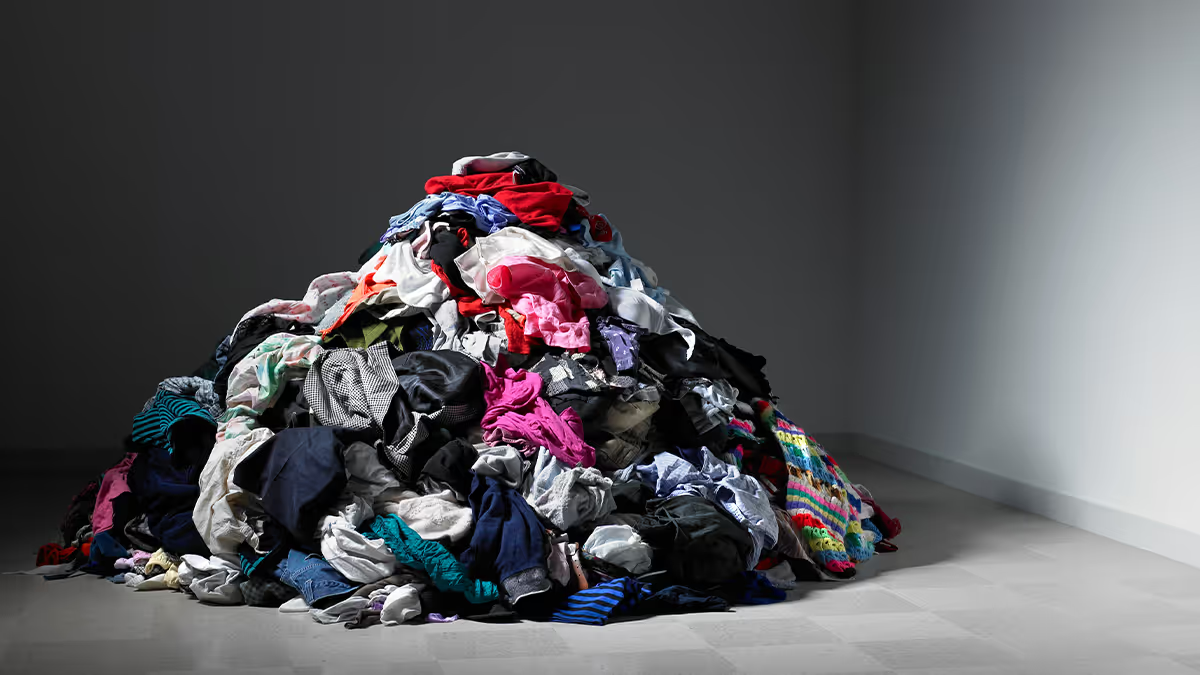
Fashion has a materials problem. Not a design problem, not a branding problem, a materials problem. The fabrics behind most of what we wear, rayon, cotton, and silk, account for roughly 80 percent of the industry’s total environmental footprint. Greenhouse gases, water pollution, and textile waste are piling into landfills at 92 million tonnes a year. The numbers are staggering, and recycling programmes and secondhand shopping, however well-intentioned, barely touch the root cause.
That’s the problem the Bezos Earth Fund decided to take seriously on April 24, 2026, when it announced $34 million in grants to research institutions working on next-generation fabric materials. Not marketing. Not pledges. Actual science.
What the Money Is Actually Funding
The $34 million is split across four institutions, each attacking the problem from a different angle.
Columbia University and the Fashion Institute of Technology are sharing $11.5 million to grow a textile fibre from bacteria fed on agricultural waste. The resulting material is designed to be strong, soft, breathable, and fully biodegradable, with no microplastics and no landfill legacy.
UC Berkeley is receiving $10 million to develop a high-performance biodegradable fibre modelled on spider silk, one of the strongest and most flexible materials in nature. The goal is to achieve performance like today’s synthetics without any of their environmental damage.
Clemson University, meanwhile, is working on something that sounds almost too good to be true: engineering cotton that grows out of the ground already coloured. No chemical dyes. No water-intensive finishing processes. The colour is built directly into the biology of the plant.
These aren’t moonshots for 2050. The brief from the Bezos Earth Fund is clear — materials that look, feel, and cost like what we already wear, but built to be better for the planet from the first moment of production.
This Isn’t Where It Started
The Fund’s fashion work actually began in 2025, with a $6.25 million grant to the Council of Fashion Designers of America for the Next Thread Initiative — funding emerging designers focused on sustainability and scholarships for students pursuing sustainable design. That was the opening move.
The $34 million is the real statement.
Lauren Sánchez Bezos, Vice Chair of the Fund, put it plainly: the science happening right now, fibres grown from bacteria, cotton engineered to emerge from the ground in colour, silk-like materials made from compost, is the future of fashion. Not a niche future. The mainstream one.
Why It Matters Beyond the Headlines
The Bezos Earth Fund was founded in 2020 with a $10 billion commitment from Jeff Bezos, the largest individual philanthropic pledge to climate and nature on record. To date, roughly $2.3 billion of that has been deployed. The clock is ticking: the full $10 billion is committed to be disbursed by 2030.
Fashion’s inclusion in that strategy is significant. It signals that the fund sees textiles not as a side issue but as a genuine lever in the climate fight. When 80 percent of an industry’s environmental damage happens before a single garment is cut or sewn, the most powerful intervention isn’t at the consumer end. It’s at the molecular level.