
You know the feeling. You pick up your phone to check the time, and fourteen minutes later, you are deep in a comment section about something that has nothing to do with your life. You did not decide to go there. You just ended up there, the way you end up somewhere when a current pulls you, and you forget to swim.
This is not a personal failing. It is, by design. The apps that live on your phone were engineered by some of the most talented minds in the world, specifically to make you stay, click, return, and stay again. Your attention is the product. The phone is the packaging. And for most of us, somewhere between the first iPhone and today, we handed over that attention without ever quite agreeing to the terms.
A small company thinks it has a different answer. And it comes in a square.
What the Meadow Is
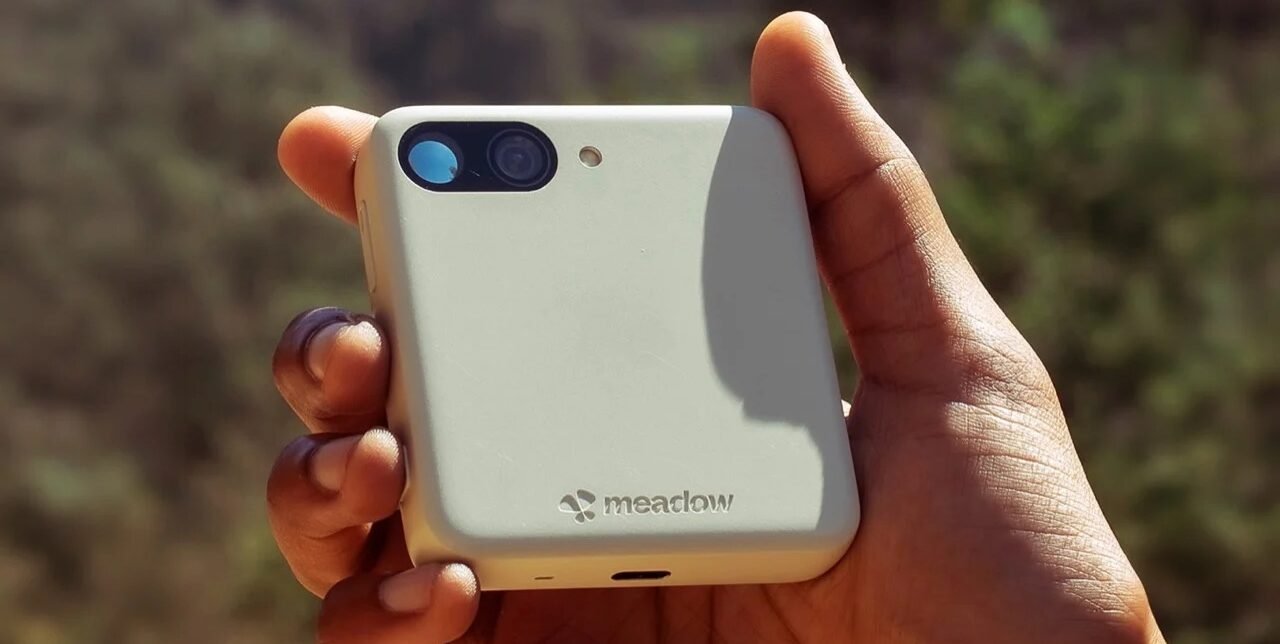
Meadow is a square-shaped phone built on a single uncomfortable premise: your smartphone is ruining your life, and you know it. It is not a dumb phone. It is not a brick. It is a secondary smartphone designed to give you the essentials: your phone number, maps, music, a camera, ride-hailing apps, and nothing else.
The device explicitly dispenses with an app store, social networks, WhatsApp, and a web browser. What remains is a deliberately curated list: calls and texts, camera, maps, Uber, Spotify, Apple Music, podcasts, audiobooks, notes, fitness, clock, and weather. Up to twelve contacts can be set whose messages and calls are displayed on the Meadow; nobody outside that circle can reach you. Your main phone can be off entirely. The calls still come through.
The included accessories, an action case, a beach pouch, and a charging cable, suggest Meadow knows exactly who this is for: people who want to go outside and do things without their phone becoming the main character of the experience.
The Shape Is the Statement
Meadow runs a modified version of Android on a 3.7-inch square display. The 1:1 aspect ratio means that apps designed for tall, narrow screens render awkwardly. Social media feeds look wrong. Video content does not fill the screen. The dopamine loops that keep you swiping at 1 am simply do not function the way they were designed to.
This is the most interesting thing about the Meadow: the design itself is the restriction. Software-based restrictions like screen-time limits, grayscale modes, and app timers require ongoing discipline. The difference with Meadow is philosophical: it bets that hardware design, not willpower, can break smartphone addiction. The friction is the product. The awkwardness is the feature.
It costs $399 to pre-order, with free returns if it is not for you, and a $10 per month subscription after the first nine months that covers unlimited calls, texts, and photo storage. Shipping begins in June 2026.
The Bigger Conversation
The Meadow does not exist in a vacuum. The minimalist phone market has been expanding steadily. The Light Phone III launched earlier this year with an e-ink display, Nokia’s parent company HMD has been releasing simpler handsets, and even Samsung and Apple have introduced increasingly sophisticated focus modes, an implicit acknowledgment that their own products create problems users want solved.
But the Meadow sits at a particular cultural moment. We are, collectively, exhausted. Not by the technology itself, but by what the technology has done to the texture of daily life. The inability to sit through a meal without checking something. The anxiety that arrives when the phone is not in reach. The strange grief of realising you cannot remember the last time you were genuinely, completely bored, and that boredom, it turns out, was where creativity lived.
In the Middle East, where the relationship with the phone is as intense as anywhere in the world, where WhatsApp is how families stay connected across countries, where social media is both business and community, the question the Meadow raises lands with particular weight. We have built so much of our daily lives inside these devices. What would it feel like to step outside them, even briefly?
A Starting Point
Meadow’s tagline is simple: “Don’t let your phone be the centre of your story.” It is not asking you to give up your smartphone. It is asking you to try, sometimes, to leave it at home. To be reachable by the people who matter, navigable, able to listen to music, able to take a photo, and unreachable by everything else.
That is not a revolution. But in 2026, in a world where the average person unlocks their phone over 150 times a day, it might be the most radical thing a small square device could offer.